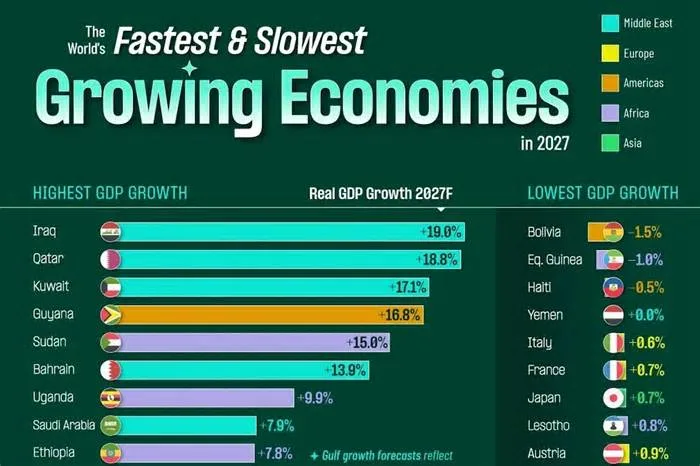
It is expected that five of the 10 fastest-growing economies in 2027 will be in the Middle East. While the global economic growth rate for this year is estimated at 3.4%, only three countries are expected to see their economies shrink.
Economic Growth in the Middle East
According to economic reports, the Middle East is positioned as the leader in global economic growth in 2027. Improvement in conditions following the Iran war will contribute to increased energy production and exports in this region. However, the realization of these forecasts depends on the return of shipping traffic through the Strait of Hormuz to pre-war levels.
Read more: 0.1% Decline in France's Economy in the Third Quarter
In this context, Iraq, Qatar, and Kuwait are at the top of the list of the fastest-growing economies, with each country's economy expected to grow by more than 17% in 2027. This growth will be driven by increased economic activities and energy exports in these countries.
Countries with the Lowest Economic Growth
Conversely, several countries globally are expected to have lower economic growth. Bolivia, with a negative growth of 1.5%, Equatorial Guinea with a negative growth of 1%, and Haiti with a negative growth of 0.5%, are the only economies expected to shrink in 2027. This situation reflects the existing economic challenges in these countries.
Globally, G7 countries are also among the economies with the lowest growth. Italy, France, Japan, Germany, and the United Kingdom are listed with growth rates of 0.6%, 0.7%, and 1.1% respectively. This occurs particularly in a context where high energy costs exert significant pressure on consumption and industrial activities in these countries.
It is expected that the economic growth of European countries will also be influenced by increasing competition from Chinese exporters. Overall, the Eurozone economy is projected to grow by only 1.2% in 2027, while the economic growth of the United States for the same year is estimated at 2.3%.
These striking forecasts are presented at a time when many countries are facing economic challenges arising from global and domestic crises. For European governments, this weak economic outlook, amid increasing commitments related to defense and infrastructure spending, puts additional pressure on public financial resources.
Read more: Canada Acknowledges Its Economic Dependence on the U.S. · Economic Growth in the Middle East in 2027 Led by Iran