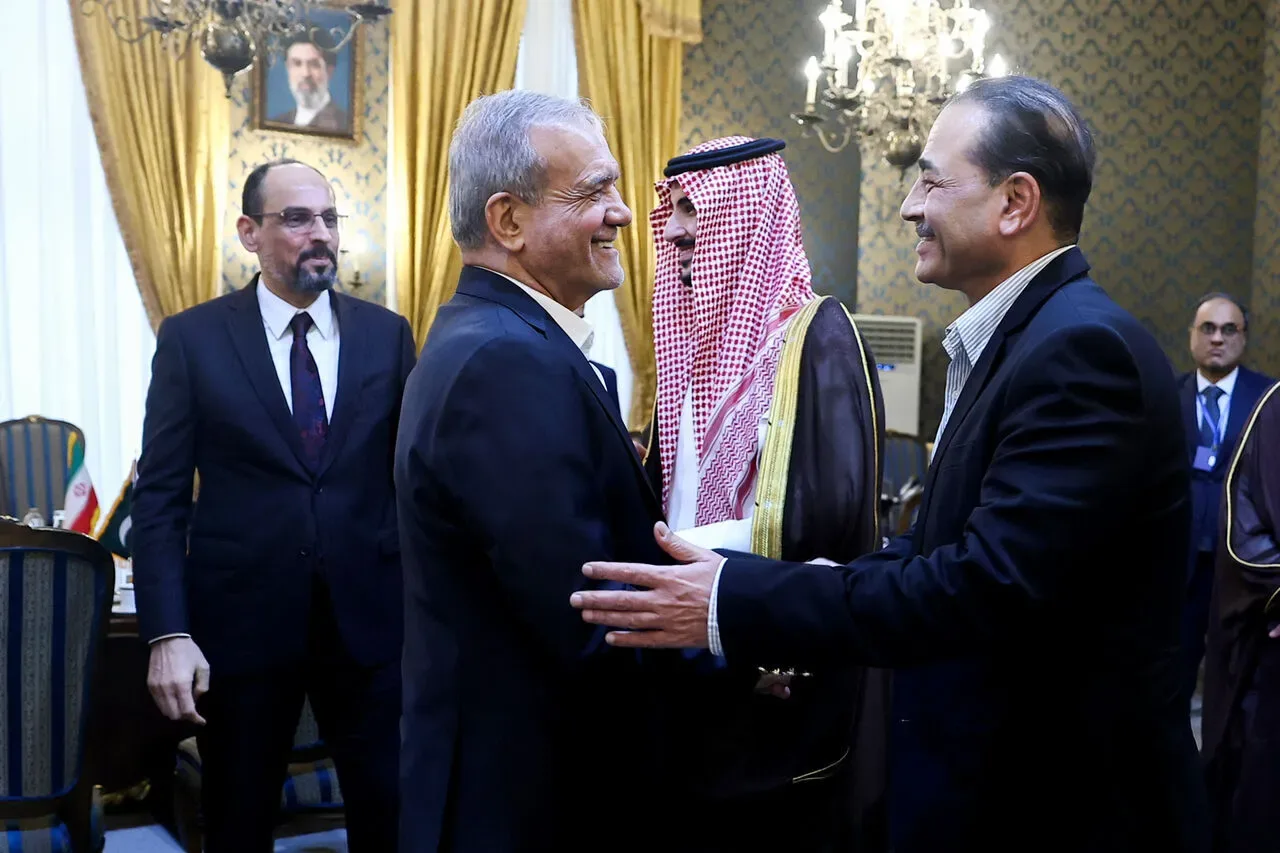
Masoud Pezeshkian, the President of the Islamic Republic of Iran, during the Tehran quadrilateral meeting with senior representatives from Saudi Arabia, Turkey, and Pakistan, emphasized the necessity of expanding economic ties as a foundation for sustainable regional security.
Turning Political Understanding into Practical Cooperation
The President, in a meeting with senior officials from the three countries, stressed the need to turn political understanding into practical cooperation. He said: "It is necessary for us to work hand in hand to create the conditions for the flourishing of scientific, economic, cultural, political, and security capacities in the region; to develop communication routes, facilitate movements, turn borders into opportunities for cooperation, and connect the universities, scientific centers, traders, and merchants of Islamic countries with each other."
Pezeshkian, in the same meeting, described strengthening scientific, cultural, and economic ties as "one of the most effective solutions for consolidating collective security in the region." This view aligns with part of the research literature on economics and international relations; literature that suggests economic ties can help maintain stability by increasing the costs of conflict. However, these studies also show that this relationship is neither automatic nor yields the same results in all regions and conditions.
The Necessity of Building Trust Among Countries
Ali Bagheri Kani, the Deputy for International Affairs of the Supreme National Security Council, in a televised interview after the Tehran meeting on October 26, 2026, said: "To achieve political trust, sustainable intra-regional security, and connectivity among countries, we need the backing of intertwined economic cooperation." He also warned: "Otherwise, political trust may be undermined, and security will not remain sustainable." According to Bagheri Kani, the details of economic cooperation were not discussed in this meeting, but the principle was raised, and following up on the issue was agreed upon for future meetings.
The more interests countries have in continuing their relationship, the greater the losses will be if it is severed. When sales markets, raw material supplies, investment, transportation, and business activities depend on relations with neighbors, confrontation will not just be a security decision; it will also jeopardize income, employment, and economic assets. In such a situation, groups with commercial interests can also become advocates for maintaining the relationship.
Jung-Wa Lee and Jo Hyun-Pyeon, in an article, pointed to the positive impact of bilateral trade interdependence on reducing the likelihood of military conflict between two partners. This view can present specific complexities in the context of the oil economies and the weakness of regional institutions in the Middle East.
Adil Malik and Jamal Ibrahim Haidar also emphasize the necessity of focusing on the economic foundations of peace, stating: "Dense trade ties act as a mechanism for ensuring compliance; they make disruption extremely costly and embed stability in the economic architecture of the region."
Meanwhile, Mohammad Javad Zarif, the former Foreign Minister of the Islamic Republic of Iran, referred to "common prosperity" as one of the foundations of regional security integration and mentioned the Tehran meeting as an opportunity to establish a "security network for West Asia."
China, as one of the global powers, can also play a complementary role in this process. Given China's economic relations with Iran and the Gulf Arab countries, it can help strengthen dialogues and reduce tensions.
Read more: Tehran Hosts Security and Military Meeting of Iran, Saudi Arabia, Turkey, and Pakistan