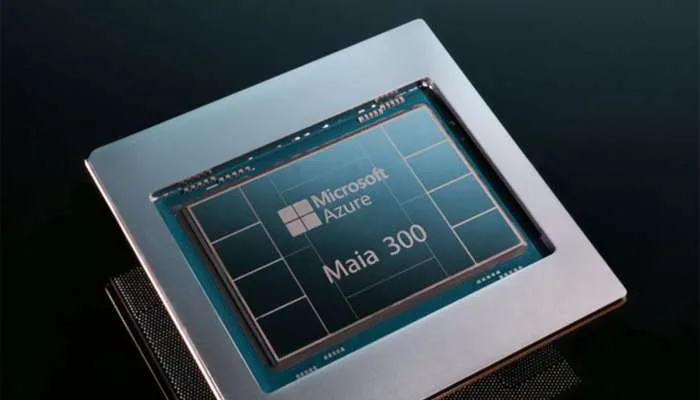
Microsoft announced its plan to expand the Azure Maia AI chip family to a multi-gigawatt scale starting in 2027. This move aims to make these chips the primary system for running AI models in its products and services, and is part of the company's efforts to enhance AI performance and energy efficiency.
Introduction of the Maia 300 Chip
Satya Nadella, CEO of Microsoft, stated in a post that this initiative represents the company's biggest risk in its silicon chip production. Nadella also unveiled the new Maia 300 chip, which is expected to produce 40% more tokens than GPU-based systems.
Chip Development and Efficiency
This expansion is based on the Maia 200 chip, which is currently in use in the United States, Europe, and Australia. Nadella noted that this chip has been able to deliver up to 1.7 times more tokens per watt in various experiences such as Microsoft Teams and Copilot.
Scott Guthrie, Executive Vice President of Microsoft in the Cloud and AI division, stated in a separate post that Maia 200 is serving production workloads that include Microsoft Copilot. GitHub Copilot and Microsoft Foundry are also expected to be added to this list by the end of the year.
The new chips are designed to run AI models more efficiently, coordinating hardware, software, memory, and networking. Microsoft stated that the experience gained from AI service operations on Maia 200 has contributed to the development of Maia 300.
The new system is designed for AI workloads that increasingly require processing power, and Maia 300 is expected to have up to seven times the token production capability of the Maia 200 in a fully configured 96-accelerator setup.
Microsoft has announced that the Maia 300 systems will combine 96 accelerators in a 167-kilowatt power enclosure, with 27.6 terabytes of high-bandwidth memory and a collective memory bandwidth of 1.7 petabytes per second.
Production of these chips will begin in 2027. Microsoft emphasized that this system utilizes a multi-chip design, and its computing chips will be built on TSMC's N2P processing technology.
Microsoft's broader strategy focuses on improving efficiency across the entire AI infrastructure while also paying attention to innovations from the technology ecosystem. With the increasing demand for AI services, Microsoft aims to position its in-house chips as a central part of its infrastructure strategy.