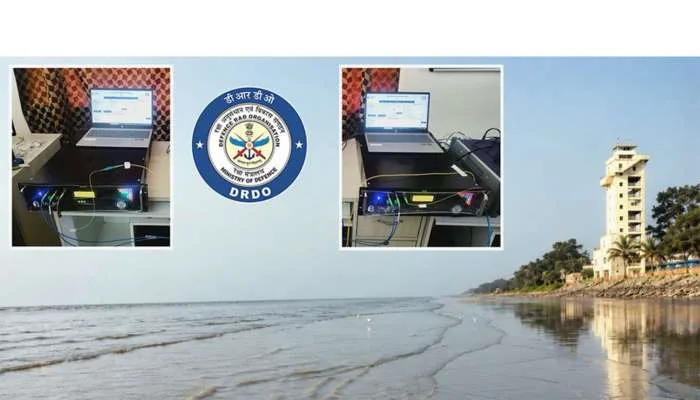
India has announced success in configuring and testing the Quantum Key Distribution (QKD) platform in a live network dynamic testing at the Proof & Experimental Establishment (PXE) in Chandipur, taking a significant step in enhancing quantum secure communication capabilities.
Enhancing Communication Security
According to the Defence Research and Development Organisation (DRDO) of India, this test demonstrates the effective application of QKD in enhancing critical observations and telemetry related to the testing and evaluation of artillery and armored weaponry. The QKD platform has been designed and developed under the microelectronics, computing systems, and cybersecurity (MCC) cluster of DRDO, and in collaboration with the manufacturing partner, Taqbit laboratory, provides unconditional security along with intrusion detection.
Read more: Microsoft Unveils New Copilot Features for Workplace Automation
Features of Quantum Key Distribution Technology
Quantum Key Distribution uses the unique properties of quantum mechanical systems to generate and distribute cryptographic key materials. Quantum cryptography employs the same physical principles and similar technologies for communication over a dedicated communication link. Published theories indicate that physics allows QKD to detect the presence of an intruder, a feature not offered in standard cryptography.
Quantum-resistant algorithms are implemented on existing platforms and achieve their security through mathematical complexity. These algorithms in cryptographic protocols ensure confidentiality, integrity, and authentication of a transmission, even against a potential future quantum computer.
Quantum communications provide fundamentally unbreakable encryption, making this technology dual-use and applicable in securing data in strategic sectors such as defense, finance, and telecommunications, as well as in protecting communications related to national security. Quantum Key Distribution eliminates the need for fiber optic installation using free space, which can be both disruptive and costly, especially in challenging terrains and dense urban environments.
These technologies are being developed under the DRDO-Industry-Academia Centers of Excellence (DIA-CoEs) program, where 15 centers of excellence have been established in top academic institutions like IITs and IISc for the development of advanced defense technologies.
Read more: New Zealand Identifies China as a Persistent State Cyber Threat · Sustainable Return of Middle Eastern Crude Oil Exports and Its Impact on India and China