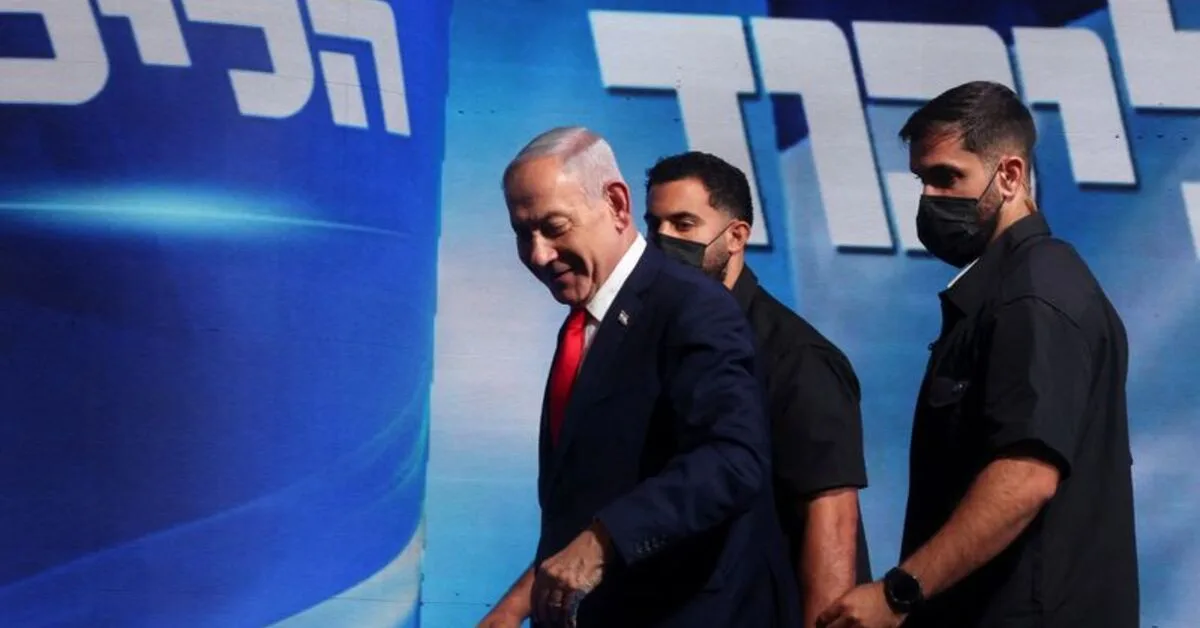
Benjamin Netanyahu, the Prime Minister of Israel, is likely to remain as caretaker Prime Minister with the strong support of the majority of Israeli Jews in an election that is considered a turning point in the history of this country.
Election Results and Political Situation
With about 70.7 percent of the votes counted, Israeli media predicted that Netanyahu's coalition, which includes right-wing, extremist, and ultra-Orthodox parties, will secure 54 seats in the parliament. Meanwhile, the rival coalition led by Gadi Eisenkot has only gained 47 seats. Additionally, parties representing Arab Jews will also capture 19 seats.
Read more: Jordan Arrests Three Suspects After Deadly Attack on Church
While Netanyahu is predicted to lose the majority of his coalition in the 120-seat Knesset, his opponents have no hope of ousting him without the support of Arab parties. Even if an agreement is reached, Netanyahu will remain as caretaker Prime Minister until a new coalition is formed or new elections are held next year.
Statements from Netanyahu and Eisenkot
In his speech at the Likud party's election headquarters in Jerusalem, Netanyahu called for the formation of "a strong, right-wing national government." He referred to Israel's historic opportunity to eliminate threats from Iran and emphasized that side considerations should not be taken into account on this path.
Meanwhile, Gadi Eisenkot emphasized that Netanyahu is still performing his duties as caretaker Prime Minister and urged him to step back from politics, warning security officials that Netanyahu might exploit security issues for his political purposes.
Eisenkot stressed: "Serve only the nation and the interests of Israeli citizens and stand firm against any attempts to pressure you. You have my full support. Netanyahu, do not dare to use Israel's security for your political needs."
This election was the first held after the attacks by armed groups from Hamas, which resulted in the deaths of 1,200 people and the abduction of 251 Israeli citizens. The war in Gaza, which led to the devastation of the region and the deaths of 74,000 Palestinians, has further isolated Israel on the global stage and caused significant shifts in global public opinion against the country.
Netanyahu himself is being prosecuted by the International Criminal Court in The Hague for war crimes and is also facing corruption charges in Israel, which he dismisses as a conspiracy by state institutions.
Political and Social Developments in Israel
The ongoing support of the majority of Israeli Jews for Netanyahu reflects decisive changes in Israeli politics, of which he is recognized as the main figure. Unapologetic Jewish nationalism, support for settlement expansion in occupied Palestinian territories, and disregard for foreign criticism have now become mainstream in Israeli politics.
Center-left parties, which were in power during the first half of Israel's history and led negotiations for land exchange for peace with Arab neighbors, have been marginalized. Almost all Jewish parties now ignore the principles of international peace negotiations that began in the 1990s by rejecting any formation of an independent state for Palestinians.
This election is considered a turning point for the country, recording a voter turnout of 77.7 percent, the highest in over two decades. Participation among Palestinian Jews, who make up more than one-fifth of the population, was particularly high, as many of them suffer from Netanyahu and his cabinet's racist behaviors.
Read more: Two British Men Charged with Security Offenses Related to Air Base · French President's Stance on Immigration Policies