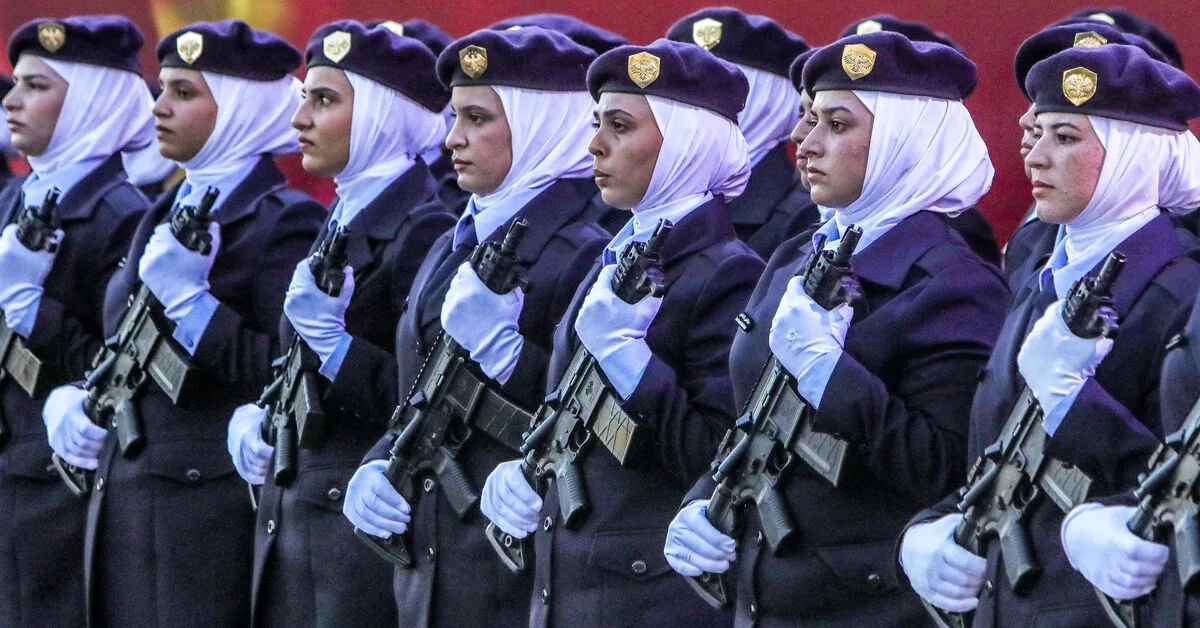
The Syrian Interim Government led by Ahmad al-Sharaa has imposed restrictions on the admission of women to the educational programs of two new universities focused on defense and security in late September. This action comes just days after Latifa al-Darawi, the president's wife, and Anas Khatib, the Minister of Interior, attended the graduation ceremony of the first group of female police officers at the Women's Police Academy in Damascus.
Contradiction in Policies and Efforts for International Legitimacy
This apparent contradiction reflects a fragile balance that al-Sharaa, who previously led a branch of al-Qaeda, is trying to achieve nearly two years after the ousting of former Syrian dictator Bashar al-Assad in December 2024. Al-Sharaa's efforts to gain international legitimacy have turned him into a moderate Islamist seeking to become one of the main allies of the West and to implement an agreement regarding non-confrontation with Israel.
In a sign of his claim to openness, the president personally awarded his university diploma to his wife at Idlib University last September. However, in September of this year, the Syrian pop icon Assala Nasri returned to Damascus and performed at a concert where tickets sold out quickly, while an organized campaign led by Egyptian cleric Hani Dahab urged people to avoid this 'sinful' event.
Marginalization of Women and Threats from Islamists
Critics view these actions as a performance designed to quell Western concerns. The temporary Syrian constitution, unilaterally declared by al-Sharaa in March 2025, explicitly states that Islamic jurisprudence is the primary source of legislation. This is while the 2012 constitution issued by Bashar al-Assad also refers to Islam as the main source of laws.
International human rights organizations have also expressed concern over these restrictions, stating that the Syrian government is rebuilding the army without the presence of women. In this context, only 22 women out of a total of 206 representatives are present in the Syrian parliament, and there is only one woman, Hind al-Khabawat, in the country's 23-member cabinet.
Raksan Muhammad, a spokesperson for YPJ, stated: “The absence of women in decision-making structures leads to the weakening of progress, democracy, justice, and equality.” While the Syrian Interim Government continuously claims to seek increased inclusivity, it seems that the role of women in this system has been severely marginalized.
Read more: Bill Ackman: Ben-Gvir and Smotrich should not be in the next Israeli government