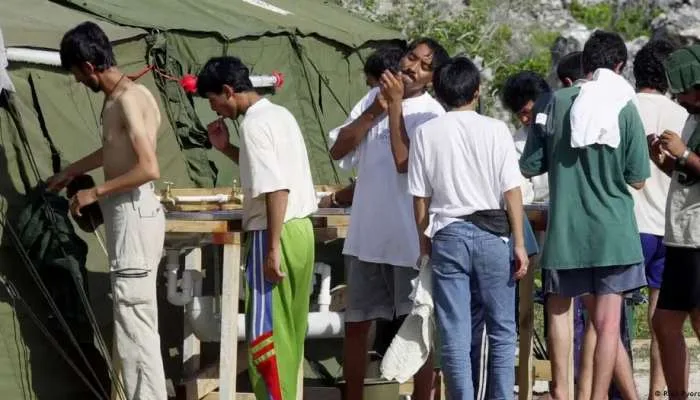
Australia's immigration policy, which includes sending asylum seekers to third countries for processing and detention offshore, incurs billions of dollars in costs and has faced numerous criticisms regarding human rights violations and financial mismanagement.
Background and Implementation of Australia's Immigration Policy
For over two decades, Australia has processed or relocated individuals outside the country where they seek support. Former Australian Prime Minister John Howard introduced the "Pacific Solution" in 2001, aimed at asylum seekers arriving by boat, establishing immigration processing centers in collaboration with the governments of Papua New Guinea and Nauru.
Read more: Romania: Two dead following a ship fire in the Black Sea
Both right and center-left governments described this policy as a deterrent measure, believing that fewer individuals would attempt dangerous sea crossings if boat arrivals did not provide a pathway to enter Australia. Howard stated in his 2001 election speech: "We decide who comes to this country and under what circumstances."
Criticisms and Humanitarian Issues
In 2008, the new Labor government gradually abandoned this approach, describing it as costly and unsuccessful. However, a crisis of deaths at sea led the Labor government under Julia Gillard to resume sending maritime applicants to Nauru and Manus in 2012.
Numerous reports of human rights violations in Australia's immigration processing program have been published. Graham Thom, the advocacy coordinator for the Refugee Council of Australia, described this policy as a "medieval idea." In 2017, a group of asylum seekers previously detained on Manus Island reached a settlement worth 70 million Australian dollars after raising allegations of misconduct and unlawful detention.
Additionally, a Senate inquiry last February introduced witnesses who referred to poor conditions, untreated health issues, and serious concerns regarding the safety and dignity of camp residents, especially women in Nauru. 73 member countries of the United Nations also publicly expressed their concerns about Australia's immigration policies.
Impacts of Similar Policies in the European Union and the United States
The European Union is considering the idea of creating return centers outside its borders, which may soon lead to the expulsion of individuals without legal residency rights in the Union to third countries like Rwanda and Uzbekistan. Meanwhile, the United States also has agreements with at least 30 countries in Africa and Latin America, and the Supreme Court has recently allowed the resumption of expulsions under this plan.
However, criticisms of similar policies in these countries also exist. For example, many human rights advocates claim that these programs lead to human rights violations and disregard humanitarian conditions.
Ultimately, assessing the success of the Australian model is difficult. The high costs of this policy, which have reached over 13 billion Australian dollars since 2012, and its social and humanitarian consequences raise questions about the effectiveness of this approach.
Read more: Marco Rubio: There is no connection between the withdrawal of American bombers from Britain and Iran's suspicious plan · Italy emphasizes the need to strengthen the EU's maritime mission in the Red Sea