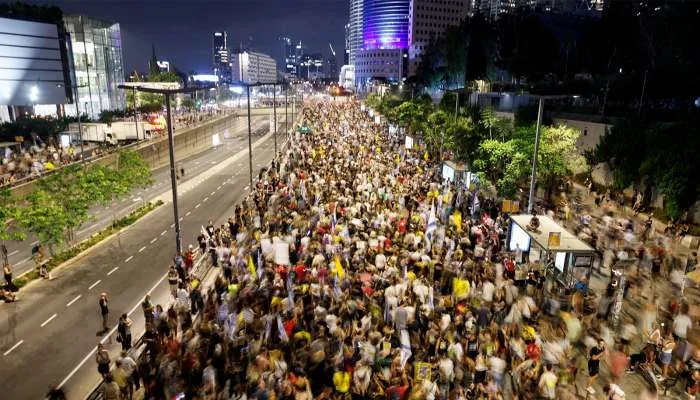
In Jerusalem, about 300 people gathered at Paris Square, Mesila Park in Tel Aviv, and UNESCO Square in Haifa, demanding the formation of a Jewish-Arab government. The protesters, holding placards with slogans "Freedom for all, from river to sea" and "Yes to a Jewish-Arab government," made their voices heard to the officials.
Response to Election Results
This demonstration reflects a joint call from participants for inclusive governance. Meanwhile, the counting of votes in the highly charged Israeli political elections continues. Preliminary results released by the Central Election Committee and various reports indicate that the electoral votes are in a sensitive state.
Read more: Turkey hosts talks on unification of East and West Libya
According to partial statistics released by the Central Election Committee by 11:35 PM local time, Netanyahu's supporting bloc holds 53 seats and the opposing bloc has 48 seats, based on 90% of the votes counted from 97.5% of the ballot boxes. This data also points to some political parties currently below the 3.25% threshold.
Analysis of the Political Situation
Currently, the parties below the threshold include "Reservists" with 2.6%, "The People of Israel" with 1.6%, and "The Haredi General Faction" with 0.2%. Election officials have emphasized that these results are not final and will change over time. In particular, the votes sent in double envelopes, which especially include votes from active-duty soldiers, are usually processed in later counting stages.
Gadi Eisenkot, head of the Yashar party and the main opposition candidate, reacted to these results by stating that this election reflects a clear lack of trust from the people in Benjamin Netanyahu's government, and he promised to continue efforts to oust the government, even if his political bloc does not achieve a parliamentary majority.
He wrote on platform X: "It is the people's demand that they show their lack of trust in the government of October 7 and their evasion of military service." Although Netanyahu's supporting parties hold 53 of the 120 Knesset seats, the opposition has secured 67 seats. However, this opposing bloc remains divided between Jewish and Arab parties.
Yair Golan, head of the left-wing Democratic Party, announced in his first media interaction after the polls closed that he intends to meet with three party leaders to discuss forming a government, although he did not disclose their names. Golan, as a member of a four-party group that includes Zionist opposition parties, is recognized as the only leader who has publicly referred to the integration of Arab parties into a coalition.
Read more: Trump's assistance to Netanyahu in forming a national unity government in Israel · Claim of leadership in Israel by Netanyahu and Eisenkot after inconclusive elections