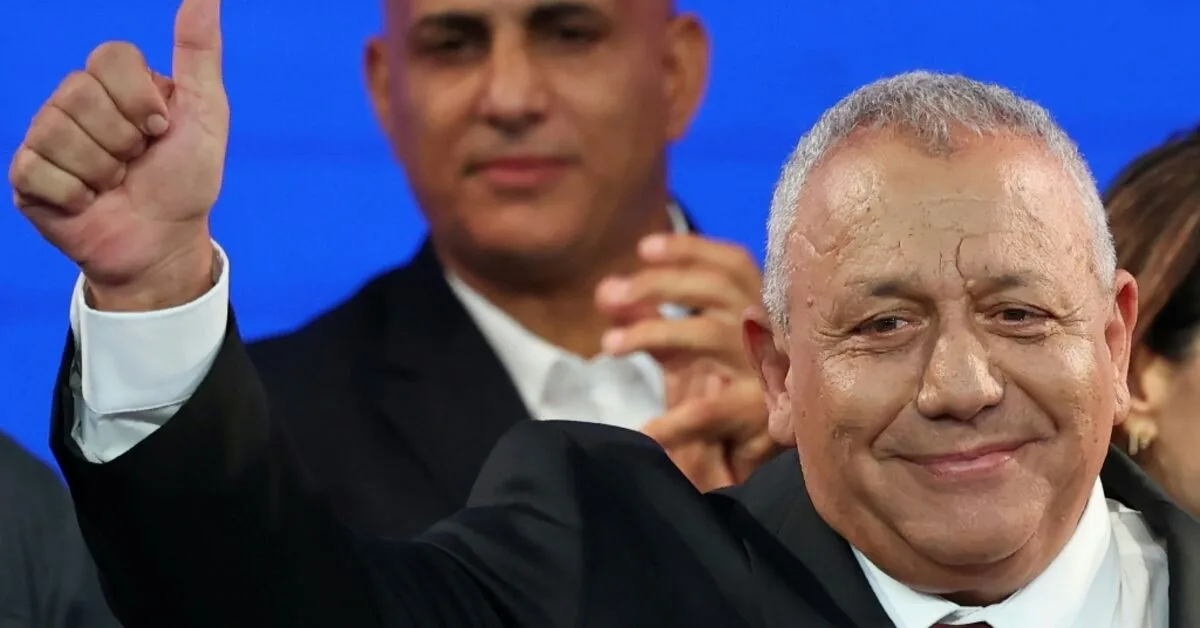
Gadi Eisenkot, the former commander of the Israel Defense Forces, is seeking support from Arab lists to form the future government of the country. The largest Arab list in Israel announced on Thursday that it supports Eisenkot, which strengthens his chances of being elected as Prime Minister compared to Benjamin Netanyahu, who has lost the support of an allied religious party.
President's Consultations and Current Political Situation
President Isaac Herzog is holding the second day of consultations with political parties following the elections on October 27. In this election, neither Netanyahu, a right-wing and controversial politician, nor Eisenkot succeeded in securing enough votes to form a majority. Herzog will choose which representative to ask to form a new government, but traditionally this task is given to someone who has been nominated by more parties, which in this case is Eisenkot.
Read more: Recep Tayyip Erdoğan Calls for Talks with Vladimir Putin About the Ukraine War
Potential of Arab Lists in Forming Government
The Arab lists achieved an unprecedented success in this election by securing 19 seats and are recognized as a potential decision-maker in forming the future government. Two Arab lists announced on Thursday that they support Eisenkot. The "Ra'am" list, which secured eight seats, also supported Eisenkot.
Meanwhile, the "Torah Judaism" party, which had supported Netanyahu in the previous five elections, did not endorse Netanyahu's proposal to be Prime Minister again during its meeting with Herzog, although it did not lean towards Eisenkot either. This party informed Herzog that it "has decided not to propose any Knesset representatives for forming a government."
The "Torah Judaism" party and the "Shas" party, as another ultra-Orthodox party, are seeking to maintain exemptions from military service for religious students. Netanyahu has maintained this exemption but has refrained from enacting it into law, while many Israelis are dissatisfied with this issue.
Eisenkot, who has attempted to reach out to secular Israelis from left to right, has firmly emphasized the end of military service exemptions. Some of his allies in opposition have criticized the ultra-Orthodox, who make up about 14% of the population, as a financial burden on the government.
Experts believe that the tactic of the "Torah Judaism" party is mainly aimed at punishing Netanyahu and showing that their votes cannot be taken for granted, while they will still serve in the government if Netanyahu forms one.
After Herzog assigns a representative the task of forming a government, that person will have 28 days to form a government, with a possible 14-day extension. If the representative fails, Herzog will assign the task to someone else.
Netanyahu's bloc, which includes "Torah Judaism," has 53 seats in the new parliament, while Eisenkot's bloc has secured 48 seats. Arab parties have achieved historic gains amid severe criticism of Netanyahu's right-wing government, whose ministers have promised to treat Israeli Arabs similarly to Palestinians in Gaza and the West Bank.
Eisenkot is capable of forming a government with the votes of Arab parties, but this may lead to losing the support of some opponents, particularly Avigdor Lieberman, a former advisor to Netanyahu and a staunch critic who nonetheless holds hardline views on Palestinians.
Netanyahu has consistently attacked opponents and has even criticized the possibility of cooperating with Arab representatives.
Read more: New U.S. Sanctions Against Indian and Turkish Companies and Individuals for Cooperation with Iran · Historic Victory for the Democratic Party in U.S. Midterm Elections and Reactions from the Middle East