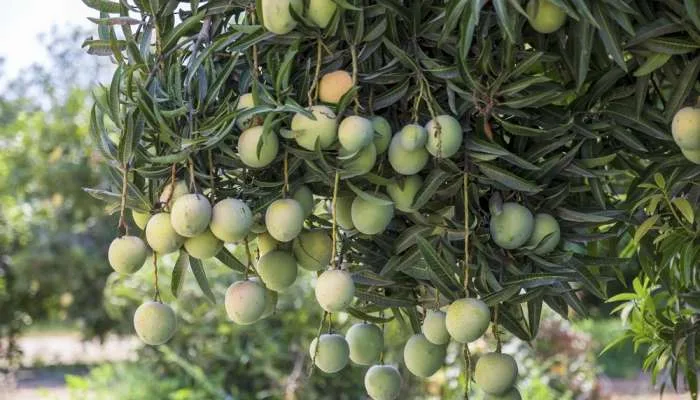
The Sultanate of Oman is taking measures to enhance investment in mango production and improve its production and competitive capacities. This effort is part of a comprehensive plan to increase domestic agricultural outputs and exploit existing gaps in production, aimed at boosting self-sufficiency and the economic value of Omani agricultural products.
Investment Opportunities and Domestic Demand
Statistical data indicates promising investment opportunities in this sector. The Sultanate of Oman imports approximately 46,211 tons of mangoes annually, valued at nearly 18.7 million Omani Rials. This reflects the high scale of domestic demand for this product and paves the way for transferring part of this value towards local production and investment, while also contributing to the development of the mango value chain.
Read more: India's Current Account Deficit Reduced to $7 Billion in July 2026
Dr. Hamdan bin Salim Al-Wahibi, Director General of Agricultural Development at the Ministry of Agriculture, Fisheries, and Water Resources, stated that the volume of mango imports is recognized as an important economic indicator of a promising domestic market. He emphasized that the private sector and investors can capitalize on this market. He added that the next phase's approach is based on changing perceptions: mangoes should be considered not only as an agricultural product but as an integrated economic value chain.
Development Programs and Scientific Research
He further explained that the Sultanate of Oman has a strong production base for further development. The current area under mango cultivation is approximately 3,907 acres, and its production in 2025 was over 17,123 tons. Dr. Al-Wahibi emphasized that future production increases will not be limited to horizontal expansion of agricultural land but will also depend on increasing productivity per unit area, improving fruit quality, enhancing water use efficiency, and selecting sustainable economic varieties.
He also pointed to the key role of the Agricultural Research Station in Sohar in providing the scientific foundation for expanding mango production. The activities of this station include species studies, evaluation of characteristics, and seedling production, along with transferring research and testing results to farms and investment projects.
Dr. Al-Wahibi added that the mango gene bank includes 252 varieties and 708 trees collected from various provinces of the Sultanate of Oman and 23 countries. This is an important foundation for selecting varieties that have the best adaptability to local conditions and the highest productivity and marketability.
He also announced that the localization program for mango production for the period 2026-2030 aims to achieve a qualitative leap in the volume of domestic production. This goal will be realized by expanding the cultivated area to approximately 10,300 acres and increasing production to nearly 44,785 tons, with an approximate production value of 17 million Omani Rials.
Dr. Al-Wahibi noted that 2026 will witness the beginning of investment opportunities in mango production. This indicates a shift from identifying import gaps to economically exploiting them through sustainable and scalable production and commercial projects.
The Director General of Agricultural Development stressed that mangoes can serve as a practical model for transforming import gaps into investment opportunities. This can be achieved by directing investment towards a product with existing domestic demand and utilizing available research capabilities and genetic resources, thereby building a value chain that generates economic returns beyond farm production.
Read more: Oman’s Ministry of Agriculture Signed Maintenance Agreements for Aflaj Worth 3.4 Million Rials · Estimated Cost of US-Iran Conflicts at $38 Billion