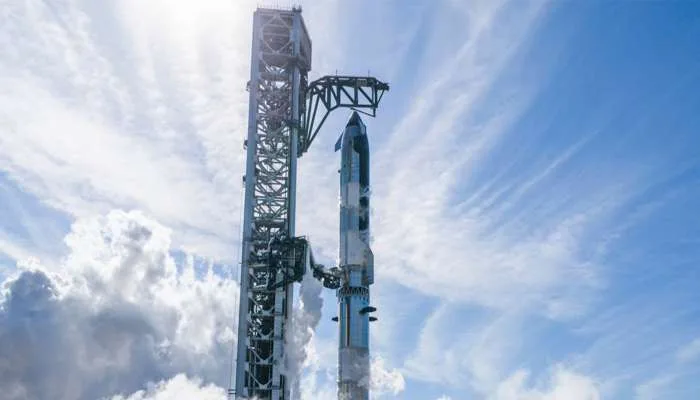
SpaceX's Super Heavy rocket, which is under the leadership of Elon Musk, is being prepared for its fourteenth flight. This flight is scheduled to take place on Monday, starting within a 75-minute window from 7:15 AM Central Time (5:45 PM IST).
Flight Objectives and Satellite Deployment
The upcoming flight is planned as the first flight to send the Starship rocket into Earth orbit. This flight will also mark the first deployment of Starlink V3 satellites in this constellation. According to SpaceX, these satellites will have high capabilities in providing faster speeds and greater reliability in global communications.
Read more: Mustafa Suleyman, CEO of Microsoft AI, raised concerns about the development of Anthropic's Claude
Specifications of Starlink V3 Satellites
The Starlink V3 satellites feature a new generation design that includes significant increases in capacity, data density, and energy production. These satellites are capable of providing 1 terabit per second in data transmission and 160 gigabits per second in data upload. This represents a tenfold improvement in data transmission capacity and a twenty-twofold improvement in data upload capacity compared to Starlink V2 satellites.
After deployment from the Starship rocket, the Starlink V3 satellites will deploy their antennas and activate their solar arrays, establishing initial communication with the ground and other satellites in the Starlink constellation via radio frequency and laser links. These satellites will then use their engines to raise their orbits.
According to SpaceX, after initial checks in orbit, these satellites should be able to start providing services to customers shortly after the flight. The primary goal of the Starship flight is to reach an altitude of about 275 kilometers above the Earth and complete approximately six orbits around the Earth during nearly 10 hours of flight.
In this flight, the Super Heavy rocket is being prepared to successfully execute the launch, ascent, stage separation, and landing at a maritime landing site in the Gulf of Mexico. Additionally, several changes have been made to the hardware and software to address issues observed in the previous flight.
According to SpaceX, Starship is the largest and most powerful rocket ever built, and both of its stages are designed to be fully and rapidly reusable, which is considered a major advancement in the field of rockets.
Read more: Turkey and the United States signed a financial assistance agreement for small nuclear reactors · The fall in the value of Solana applications: Is this the end of the road?