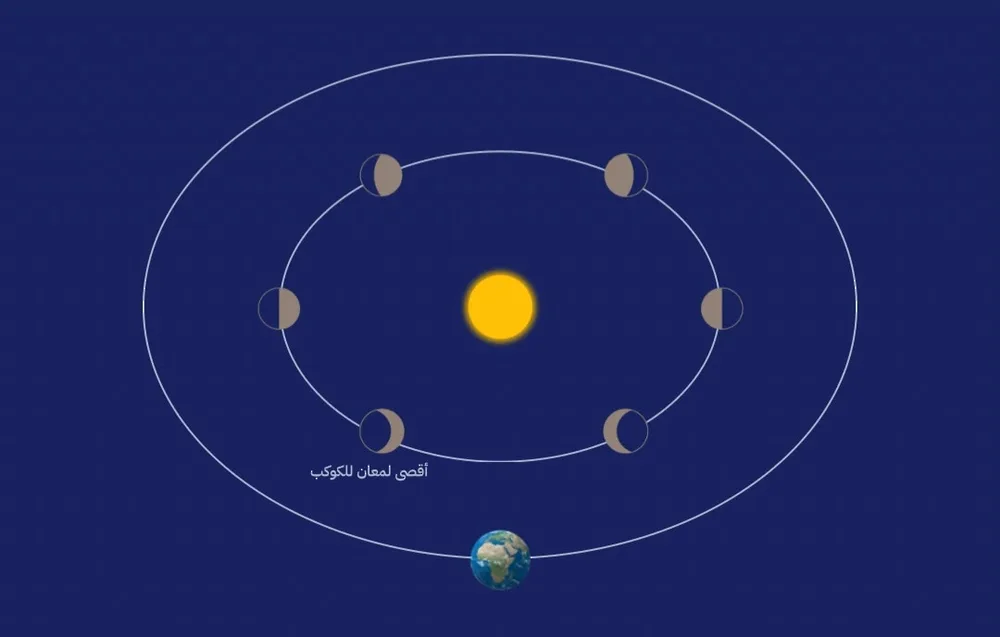
Planet Venus will be visible next Tuesday evening with an unmatched brightness in the sky of the Sultanate of Oman. This planet, with an apparent magnitude of about (−4.8), is recognized as the brightest planet in the sky and the third celestial body visible from Earth after the Sun and the Moon.
Features of Venus's Brightness
Wisal bint Salem Al-Hinai, the head of the Social Communications Committee at the Omani Astronomy and Space Association, announced that Venus will be visible as a bright point in the sky during this period. This brightness is due to the planet's relative proximity to Earth and its ability to reflect sunlight. Al-Hinai also noted that the brightness of Venus during this period does not mean it is at its maximum angular distance from the Sun.
Read more: Indian Arunima is safe after a brief detention in Afghanistan
The Monthly Phenomenon and Observing Venus
As an inner planet, Venus experiences various phases in its orbit between Earth and the Sun, similar to the phases of the Moon. During this period, Venus is in a state where its large apparent size and proximity to Earth, along with the suitable light from its surface, cause its remarkable brightness.
Al-Hinai also pointed out an interesting fact that at its maximum brightness, not all of Venus's surface is illuminated, and it appears crescent-shaped. This phenomenon occurs due to the planet's proximity to Earth and the increase in its apparent size while its illuminated area decreases.
As this phenomenon continues, Venus gradually moves closer to the Sun in the evening sky and will eventually reach its inferior conjunction on October 24. At this time, Venus will be positioned almost between Earth and the Sun, making it difficult to observe. After this date, the planet will gradually appear as a celestial body in the morning sky.
Al-Hinai invited astronomy enthusiasts to observe Venus from locations with an open western horizon and no obstructions. Observing Venus with the naked eye is possible, but using a telescope can reveal more details of its phases.
Venus is known as the brightest planet in the solar system and is commonly referred to as the "Evening Star" and "Morning Star," with its brightness resulting from sunlight reflecting off its dense atmosphere.
Read more: The Indian Film Academy Awards return to Abu Dhabi