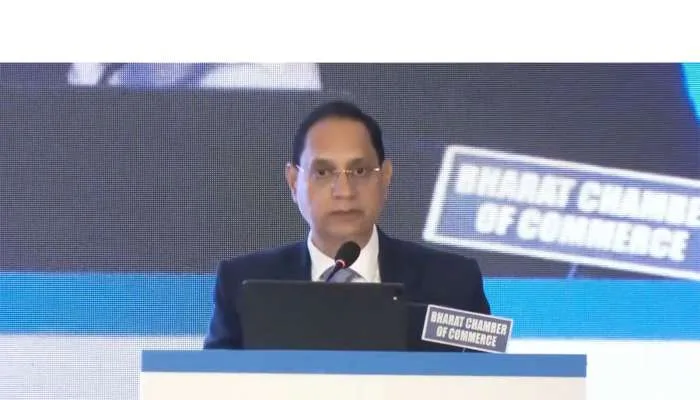
The Securities and Exchange Board of India (SEBI), led by Ajay Kanta Pandey, announced on Saturday that the agency is working to enhance access, efficiency, and resilience in India's capital markets. The main goal of these efforts is to simplify financing processes and strengthen investor protection.
Development of Capital Markets and Household Investment
At an event marking the 125th anniversary of the Indian Chamber of Commerce, which also introduced the "Investor Forum of the Indian Chamber of Commerce," Pandey emphasized that building world-class capital markets requires more than just increasing market capital and trading volumes. He stated that household savings must be connected to productive investments.
He stated, "Good businesses must be able to access appropriate forms of capital through efficient and transparent processes." Pandey outlined the measures taken by the agency to facilitate capital formation and improve business conditions.
Reforms in Stock Processes
The Securities and Exchange Board of India has optimized the initial public offering (IPO) processes, reduced timelines related to rights issues, and streamlined listing requirements for large issuers. Founders have also been allowed to retain certain employee stock options post-listing under specified conditions.
In the debt market segment, the agency has reduced listing timelines for public offerings and permitted debt securities with lower face values, while also easing the requirement for commercial banking for some eligible issuers in conducting private placements.
Pandey clarified that these measures aim to reduce the costs of issuing securities while maintaining appropriate protections. He added that SEBI is reviewing its regulatory processes to make compliance proportionate and risk-based without compromising market sovereignty and integrity.
Significant Development of India's Capital Markets
Pandey pointed to the growth of India's capital markets, stating that market capitalization has increased by about 17 percent annually over the past decade. The assets of mutual funds have also grown by about 20 percent annually. The number of unique investors in the securities market has quadrupled since the financial year 2019, reaching over 15 crore (150 million).
Companies have raised over 98,000 crore rupees through 189 initial public offerings in the first half of the current financial year, while the outstanding corporate bonds have reached approximately 61 lakh crore rupees.
Pandey also noted the increase in participation from West Bengal, stating that the number of securities market investors from this state has risen to over 90 lakh (9 million) from about 12 lakh in the financial year 2015, with nearly 36 percent of this number being under 30 years of age.
He emphasized the importance of increasing reliance on technology, stating that cybersecurity, operational resilience, monitoring, and risk management are of special significance, and that world-class markets must remain resilient even during periods of stress.