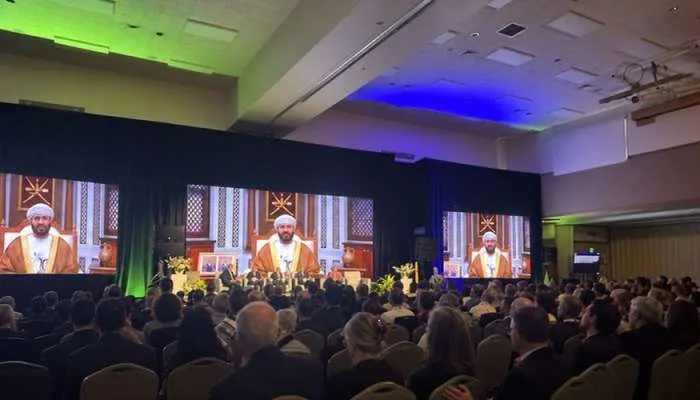
The Sultanate of Oman, representing the Ministry of Awqaf and Religious Affairs, participated in the G20 Interfaith Forum held in Salt Lake City, Utah, United States. This forum was titled "Resilient Hope, Shared Future."
Speech by the Minister of Awqaf and Religious Affairs of Oman
During the event, Dr. Mohammed Saeed Al-Maamari, the Minister of Awqaf and Religious Affairs of Oman, spoke at a general session on the topic of "Energy Policies, Religion, Peace, and Human Welfare." In his speech, the minister examined the relationships between energy resources and the values of justice, sustainability, and peace, emphasizing the importance of transforming resources into shared welfare that preserves human dignity and the rights of future generations.
Read more: Emmanuel Macron Intensified Actions Against Rioters in France
Oman's Civilizational Experience and Coexistence Model
Al-Maamari, in his speech, referred to the civilizational experience of the Sultanate of Oman and its centuries-old interactions with the nations of the world through maritime navigation, recalling the relations between Oman and the United States established by the 1833 treaty. He also mentioned the Omani ship "Sultana," which arrived in New York in 1840, bringing the first Arab representative to the United States.
The Minister of Awqaf and Religious Affairs emphasized the aflaj system, five of which are listed as UNESCO World Heritage sites, depicting the responsibility of managing resources and preserving the rights of others. He also referred to the waqf system, whose impact continues through generations.
Al-Maamari noted that Oman's model of coexistence is based on dialogue, good neighborliness, and mutual respect, referencing the "Message of Peace" and "Human Coexistence" projects that have played a role in raising awareness about shared human values. He also mentioned the launch of the "Muscat Initiative" in June this year from the United Nations headquarters in New York, carried out in collaboration with the United Nations, the United Nations Alliance of Civilizations (UNAOC), and the Network of Religious and Traditional Peacemakers.
The Minister of Awqaf and Religious Affairs urged G20 leaders to design energy and development policies that maintain energy security while considering the rights of future generations.
In conclusion, he emphasized that energy security in an interconnected world cannot be achieved for anyone unless it is achieved for all, and sharing resources requires sharing responsibilities.
This forum addressed various international issues, including the role of religious institutions in promoting peace and sustainable development, interfaith dialogue, the ethics of artificial intelligence, and contemporary human challenges.
Read more: Challenges of Securing Uranium in the Context of Global Nuclear Energy Expansion · Oman Local Content Executive Committee Meeting Focused on Economic Development