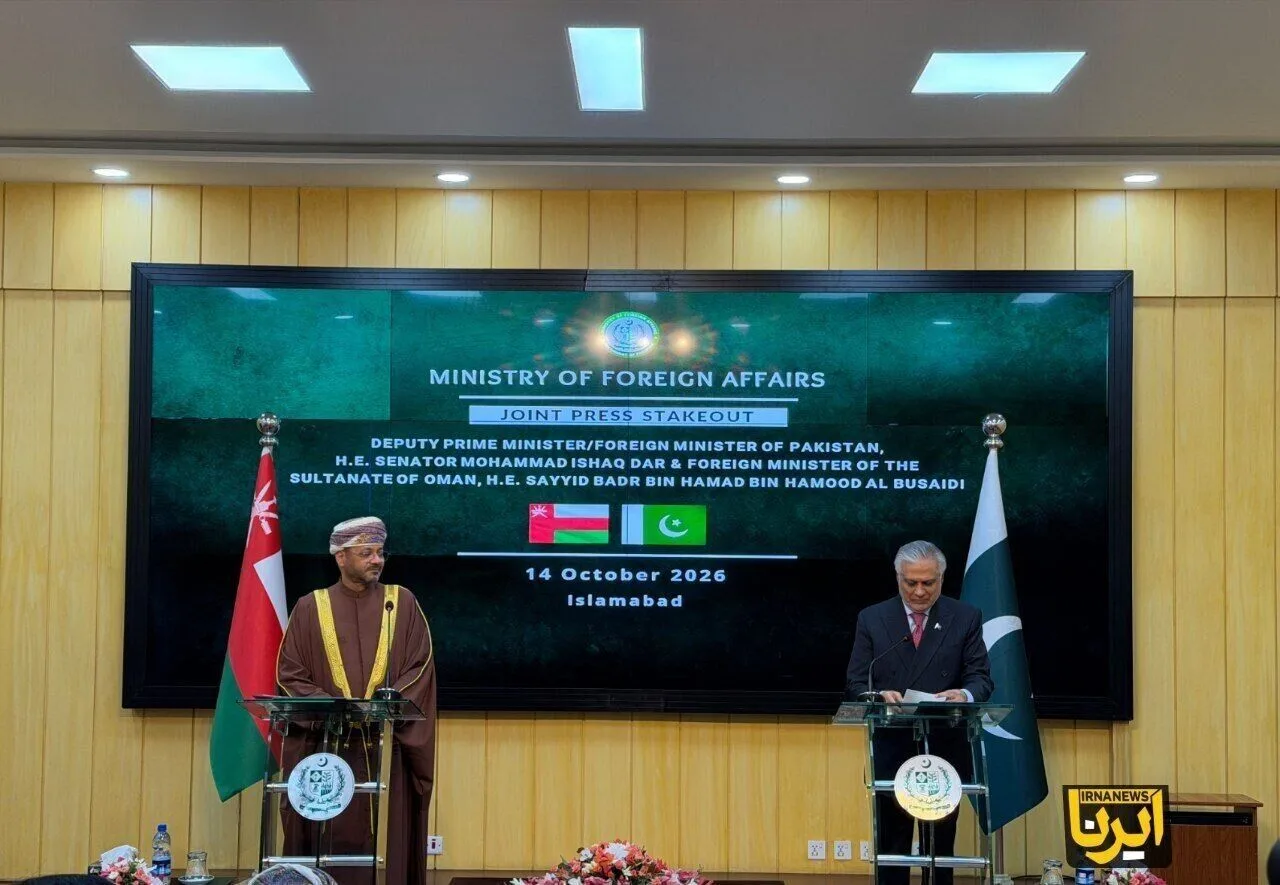
The Deputy Prime Minister and Foreign Minister of Pakistan emphasized the importance of dialogue and the return of all parties to diplomacy during a press conference with their Omani counterpart, calling for restraint.
Meeting in Islamabad
Senator Muhammad Ishaq Dar stated today in Islamabad during a joint press conference with Badr al-Busaidi, the Foreign Minister of the Sultanate of Oman, that they discussed the situation in the Strait of Hormuz and the Bab el-Mandeb Strait. He added, "Pakistan seeks free transportation in the Strait of Hormuz and Bab el-Mandeb to ensure food and energy security for everyone in the region and other parts of the world."
Regional Developments and the Need for Restraint
Ishaq Dar, referring to developments in Yemen and Saudi Arabia, also examined the situation in Palestine and condemned the illegal settlement activities in the occupied Palestinian territories, emphasizing the need for restraint from all parties in the region. He clarified that Islamabad will continue to play a role in helping to achieve peace in the region.
Badr al-Busaidi, the Foreign Minister of the Sultanate of Oman, also emphasized his country's position in support of diplomacy during this meeting, referring to ongoing efforts with other regional actors to achieve lasting peace. He said, "Both countries have direct communications regarding regional developments, and Oman commends Pakistan's efforts to mediate between Iran and the United States and to facilitate the advancement of negotiations."
Diplomatic Challenges and Oman's Role
The Foreign Minister of Oman also stressed that confrontation is not an option and that Muscat believes in diplomacy and will continue its efforts for peace. Following the 40-day war between the United States and the Israeli regime against Iran, an agreement was signed between Islamabad and Tehran, mediated by Pakistan, aimed at halting hostilities and paving the way for a final agreement between Tehran and Washington.
However, the implementation of this agreement faced obstacles due to the sabotage and breaches of trust by the United States. The renewed attacks by this country on Iran and Washington's failure to meet its commitments hindered the process of reaching a final agreement. In this context, Tehran has emphasized the necessity for the United States to adhere to the commitments outlined in the Islamabad agreement and believes that the continuation of the diplomatic process and achieving a sustainable agreement requires Washington to cease actions contrary to the agreements made.
Read more: The hunger strike of 70 political prisoners in Bahrain continues · Dialogue between the Foreign Ministers of Iran and Oman regarding regional developments