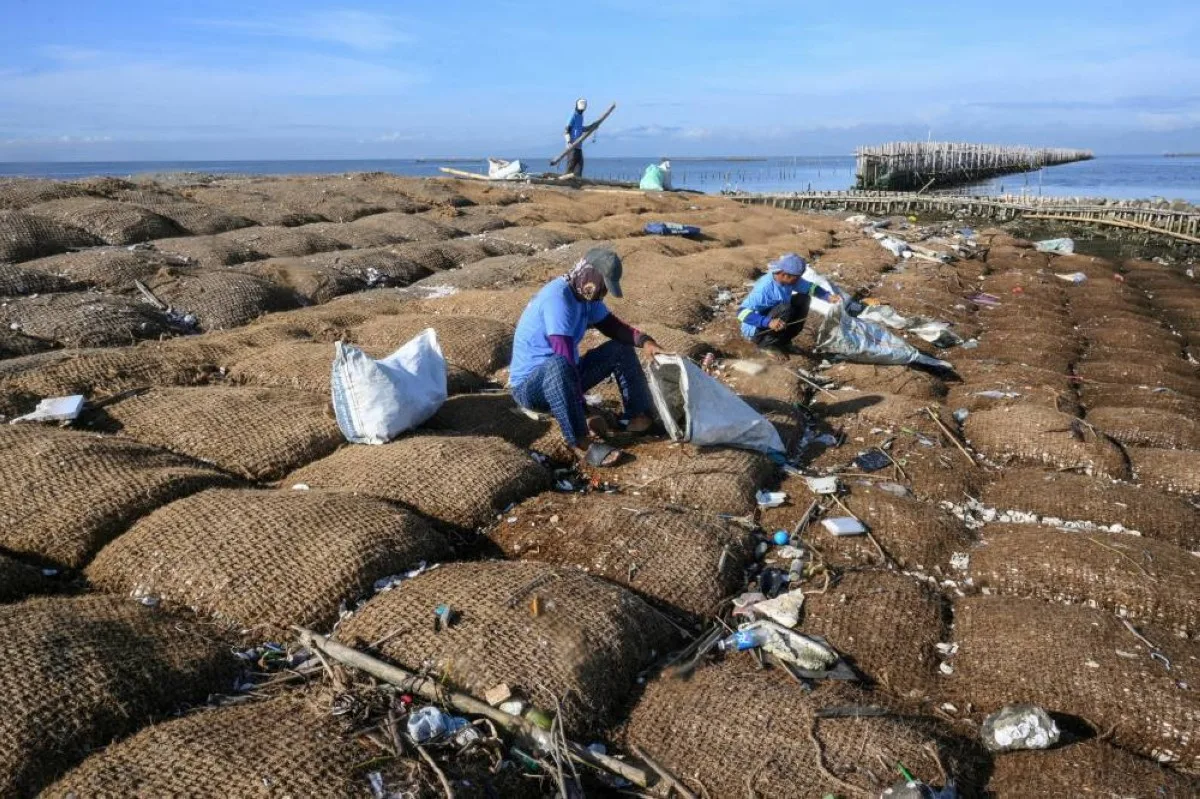
Pamarawan Island in the Philippines, located north of Manila, with a population of over 3,000, has turned to natural solutions instead of concrete to combat flooding. The island's residents, who had raised their homes with layers of concrete for years, have now built walls using bamboo and discarded shells that weaken waves and help manage flooding.
A Novel Approach to Climate Crises
This natural approach has emerged as an alternative to concrete infrastructure in a country still suffering from billion-dollar scandals in flood control projects. Malolos Mayor Christian Natividad stated that concrete projects alone will not be sufficient, and the island's residents decided to change this method due to fears of severe storms.
Read more: Pacific countries emphasize the need for global efforts to limit warming
Since May of last year, workers, many of whom are residents of the island, have been installing bamboo poles along with tree branches on the island's shores to slow down water flow and trap sediments. The goal is to gradually raise the sea bed and support the growth of mangrove trees. On a recent visit, workers were constructing a broken wall of shells about 100 meters offshore, placing bags filled with coconut fibers and shells into it.
Lower Costs and Greater Efficiency
This project covers approximately 14 hectares of Manila Bay's shores, costing around 70 million pesos ($1.1 million) along with maintenance, while the cost of a concrete wall is estimated at about 90 million pesos. Bamboo poles are expected to need replacement every five years.
Antonio Contreras, a Filipino scientist, emphasized that the Philippines has long relied on concrete walls and dams, but these methods need to be complemented with natural solutions to effectively address the challenges posed by flooding.
With the completion of the first phase of this project expected by late 2025, residents have reported that the waves have weakened. Arsenia Cabiyago, a 58-year-old fishmonger, said, "Our feet are finally dry. It wasn't like this before." A scientific assessment scheduled for next year will determine whether mangrove planting will commence. Natividad added, "Fighting water is tough. Now we are trying to live with water. We are building with nature."
Read more: Closure of Ras Al Khaimah beaches in the UAE due to oil spill · Sultanate of Oman ready to participate in COP31 climate change conference in Turkey