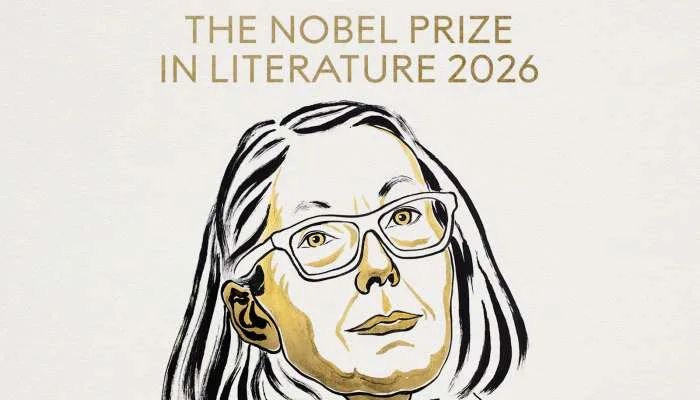
Anne Carson, the prominent Canadian writer, received the 2026 Nobel Prize in Literature on Thursday for "her bold and innovative works that create new forms for contemporary literature in a playful dialogue with the classical tradition."
Life and Works of Anne Carson
Anne Carson was born on June 21, 1950, in Toronto, and throughout her professional career, she has moved between poetry, translation, and teaching. Much of her work examines the relationship between language, classical texts, and the creation of new literary forms. According to the Nobel organization, Carson's writings stem from the intersection of "linguists' obsession with words and poets' desire for new meanings."
Read more: Official opening of the Crowne Plaza Manhattan Times Square by ARTIC
Carson has established a close relationship with classical literature, and her translations from classical Greek include pieces by Sappho in the book "If Not, Winter" (2002), as well as "Electra" by Sophocles (2001) and "Antigone" (2015) and "Bacchae" by Euripides (2015).
Innovation in Contemporary Literature
The Nobel organization particularly noted Carson's ability to gather seemingly disparate literary voices and traditions. Her works often place classical writers alongside modern authors, enabling the creation of "unexpected literary forms." One early hallmark of her work is the book "The Beauty of Husband" (1986), in which Carson examines love through the lens of Sappho's poetry and describes the tension between lovers as a source of poetic energy.
In the book "The Lost Economy" (1999), the sixth-century Greek poet Simonides of Ceos is placed alongside Paul Celan, and in "Men in Hours of Leisure" (2000), historian Thucydides converses with Virginia Woolf. The Nobel organization has announced that through these "unexpected literary forms," Carson has moved away from lyric poetry focused on a single vehicle and inspired new forms of contemporary literature.
The book "Red Biography: A Novel in Verse" (1998) is a prime example of Carson's ability to reconstruct classical materials. This work is inspired by fragments of the sixth-century poet Stesichorus about Geryon, the red-winged monster. Carson transforms this mythological character into a vulnerable young figure, turning the ancient story into a contemporary narrative of coming of age.
Carson also addresses intimate subjects in her works through unconventional literary forms. The book "The Beauty of Husband: A Fictional Essay in 29 Tangos" (2001) explores a broken marriage with a blend of prose and poetry, each of its 29 sections beginning with lines from the Romantic poet John Keats.
One of Carson's distinctive works is "Nox" (2010), published in memory of her brother Michael. This work, instead of taking the traditional book form, is presented as a box containing an accordion-fold sequence of photographs, letters, and texts. This work includes Carson's translation of Catullus's famous elegy for his brother and creates a link between ancient mourning and Carson's personal loss.
The Nobel organization described this work as "an creation as much sculptural as it is literary." Carson's innovations continue in her later works. The book "Float" (2016) consists of 22 booklets that can be read in various orders, while "Normal Error," published in 2024, brings together a diverse collection of texts with a strong performative element.
Carson has also expanded the boundaries of traditional literature through collaborations with visual artists, dance designers, opera productions, and theater directors. The Nobel organization stated that Carson's willingness to traverse "various artistic and academic fields" demonstrates her freedom in approaching established literary conventions.
Throughout her career, Carson has combined scholarship and creative writing, using classical texts, linguistic investigation, and contemporary experience to challenge the boundaries between poetry, fiction, essay, and translation. The 2026 Nobel Prize in Literature, according to the Swedish Academy's citation, recognizes precisely that ability to transform inherited literary traditions into new forms.
Read more: The passing of Muhammad bin Eid Al-Arimi, Omani writer, at the age of 72 · Canadian poet and writer Anne Carson wins the 2026 Nobel Prize in Literature