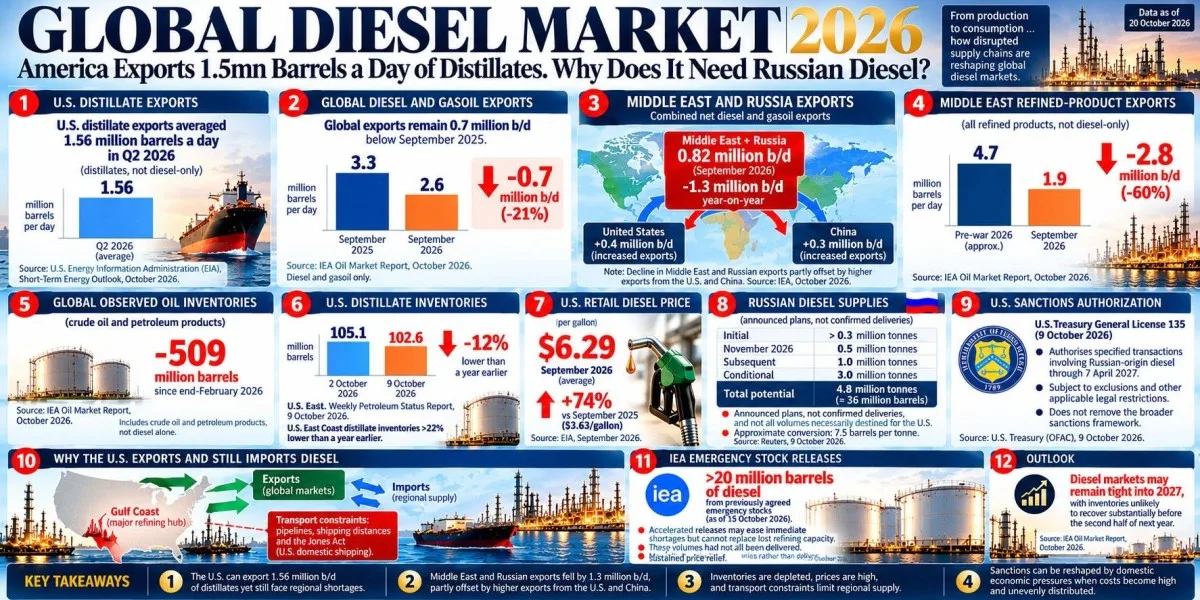
America has exported an average of more than 1.5 million barrels of refined fuel per day in the second quarter of 2026. However, Washington has turned to Russian diesel due to rising domestic fuel prices. This apparent contradiction reveals the weakness of global energy markets: abundant production does not necessarily mean affordable supply in the needed locations.
Export Status and Domestic Prices
According to the U.S. Energy Information Administration (EIA), the average refined fuel exports from America in this quarter have been 1.56 million barrels per day, while the retail price of diesel reached an average of $6.29 per gallon in September. The diesel supply agreement from Russia announced on October 9 indicates that refining constraints, inventory reductions, and transportation costs can turn national energy strength into regional vulnerability.
Read more: Saudi Arabia Postpones 'Davos in the Desert' Conference Until 2027
Declining Exports and Supply Challenges
October's report from the International Energy Agency shows that net diesel and gasoil exports from the Middle East and Russia fell to about 820,000 barrels per day in September. This is a decrease of 1.3 million barrels per day compared to last year. Although increased exports from America and China have compensated for part of this decline, global diesel and gasoil exports remain about 700,000 barrels per day lower than the September 2025 level.
Kuwait, with a refining capacity of approximately 1.415 million barrels per day, including 615,000 barrels per day at Al-Zour, and the United Arab Emirates with the Ruwais complex having a capacity of 922,000 barrels per day, are active in this regard. However, Middle Eastern refined product exports in September only reached 1.9 million barrels per day, which is a significant decrease compared to about 4.7 million barrels per day before the disruptions.
A decline in exports does not mean a loss of production. Shipments may be redirected, consumed domestically, or delayed. However, the reduction in available shipments intensifies competition among importers and raises delivery prices and refining margins.
The agreement with Russia for diesel supply, despite existing refining capacity challenges, may help meet regional needs but cannot fully compensate for the global production shortfall.
Read more: Ongoing Economic Challenges in Bethlehem, United States · Emmanuel Macron Guarantees Diesel Fuel Supply from Gulf Countries