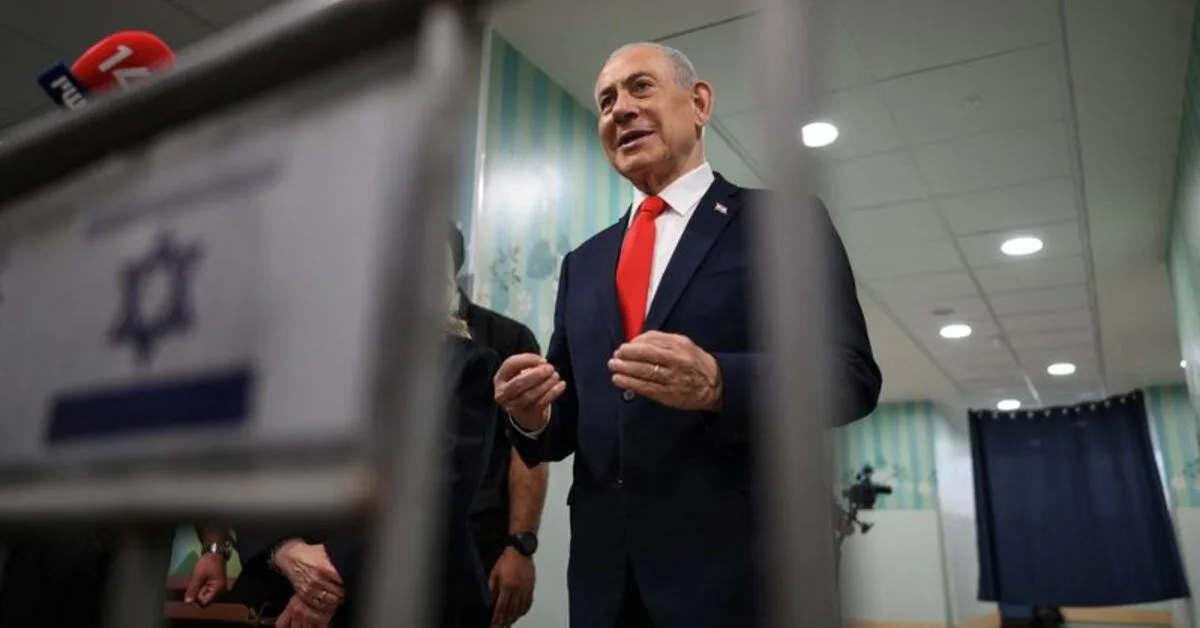
Benjamin Netanyahu, the Prime Minister of Israel, achieved a relative advantage in the recent elections in the country as votes were counted. However, losing the parliamentary majority has made his continuation in office dependent on forming a coalition with political rivals.
Election Results and Political Situation
In the elections on Tuesday, voter turnout reached a record high, with nearly 86 percent of votes counted. Three major Israeli media outlets predicted that Netanyahu's bloc, which includes right-wing, extremist, and ultra-Orthodox parties, secured 53 seats in the parliament, while the opposition bloc led by Gadi Eisenkot obtained 48 seats. Both blocs still fell short of the 61 seats needed to form a majority in the Knesset, or parliament.
Read more: Yemen and the Rise of the Houthis as a Regional Power
Aviv Bushinsky, a former advisor to Netanyahu, described him as the winner of this election despite not achieving a majority, stating that this election could lead to a revival of his political position. Despite criticisms of Netanyahu's security failures following the Hamas attacks on October 7, 2023, he managed to gain the strong support of the majority of Israeli Jews.
Challenges Facing Netanyahu and His Rivals
Dani Citrinowicz, a regional analyst and former Israeli military intelligence officer, believes that Netanyahu's victory is more about his survival in power than a real win. Netanyahu's bloc lost seats in the recent elections, and the Eisenkot bloc also needs support from Arab parties to gain power.
Netanyahu will remain as the caretaker Prime Minister while the President of Israel decides whom to invite to form a government. Despite the lack of a parliamentary majority, he still holds the power of incumbency and can work towards forming a coalition government. In this election, the highest voter turnout was observed among Israeli Arab voters, which could have a significant impact on Israel's political future.
In his post-election speech, Netanyahu spoke about forming a right-wing national government and emphasized that Israel is in a historic position to confront the Iranian threat. He called on the U.S. government led by Donald Trump to support him in inviting his political rivals to cooperate.
Political analysts believe that if Netanyahu fails to form a broad coalition, the country may head towards new elections. However, it seems that many parties are seeking to avoid holding new elections, as this could further strengthen Netanyahu.
Netanyahu faces various challenges, including a corruption trial, criticisms over security failures, and rising violence from settlers in the West Bank. While his rivals attempt to distance themselves from him, Israel's political situation will be heavily influenced by this election.
Read more: Gulf Rift Over the Future of Iran and the Approaches of the UAE, Qatar, and Saudi Arabia · Unprecedented Participation of Arab Israelis in Elections and Its Impact on Politics