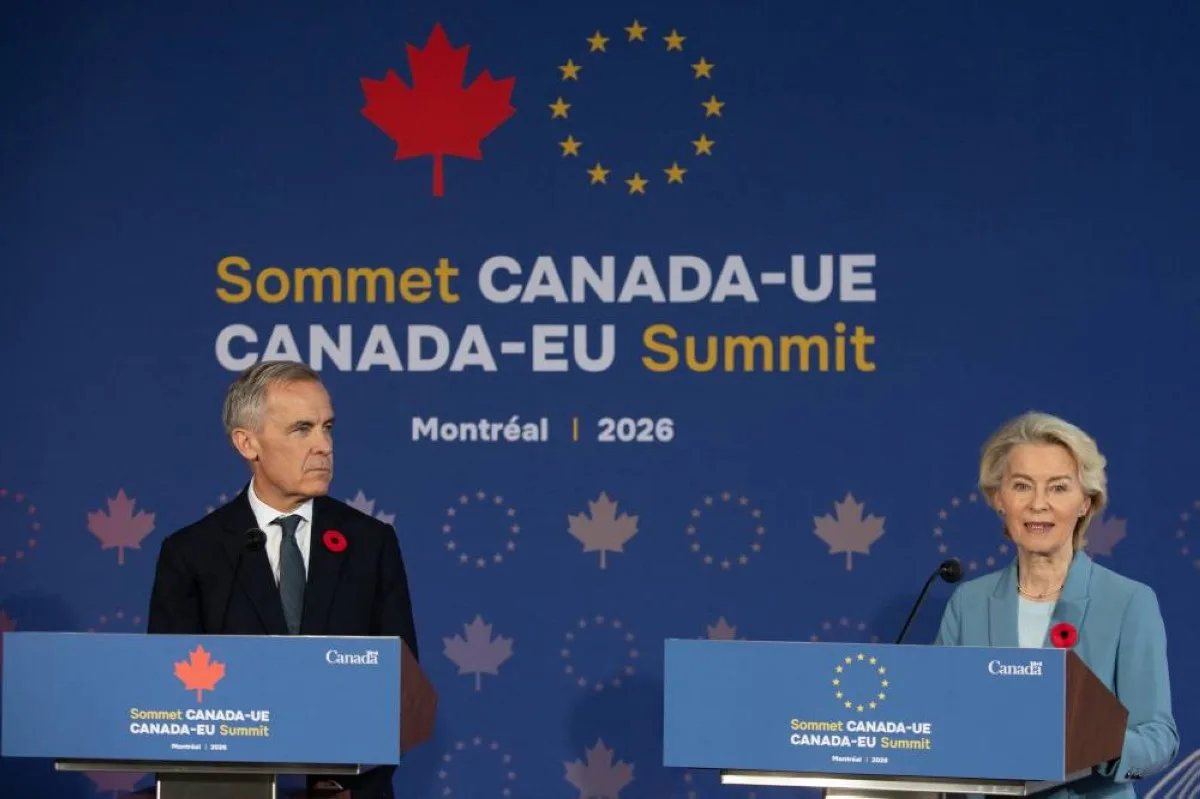
On Friday, Canada and the European Union announced a new cooperation aimed at strengthening their relationship amid geopolitical changes and the United States' separation from its traditional partners. At the end of a two-day summit in Montreal, Canada agreed to provide €90 billion (equivalent to $103 billion) in financial support for Ukraine and also signed agreements for closer cooperation in the fields of mining and artificial intelligence technologies.
Emphasis on Shared Values
Mark Carney, the Prime Minister of Canada, during a press conference, spoke about the need to strengthen the shared values of both parties in light of dangerous and divided global conditions. He referred to new challenges arising from the weakening of democratic norms and the "weaponization of trade" and stated: "Together, Canada and the European Union will stabilize our ground to support our values and create a supportive environment for the growth of our citizens." These remarks came after Carney's discussions with EU leaders, including Ursula von der Leyen and Antonio Costa.
Economic and Security Cooperation
Canada and the European Union currently have a free trade agreement and have made further efforts to strengthen their relations since Trump's return to power. Both parties face tariff challenges and territorial threats. At the Montreal summit, they outlined a two-tier partnership that, according to the President of the European Commission, von der Leyen, "is not against anyone, but is for our mutual strengthening."
Carney supported von der Leyen and used the term cooperation. He announced that the "nature" of this cooperation will be determined in the coming months. Under this agreement, Canada will regularly participate in EU meetings. Costa, the President of the European Council, announced that Carney will attend the EU leaders' summit in June, and European commissioners and Canadian ministers will also have a separate meeting in the spring.
Von der Leyen also stated that Canada and the European Union will form the "core" of a "coalition for the future" that will also be open to other partners. Carney added that this coalition will focus on enhancing shared sovereignty and resilience in the fields of artificial intelligence, energy, critical minerals, and other areas.
A senior EU official stated that coordinating economic security measures, such as tariffs, will be a key part of this cooperation to prevent unintended harm to group members.
To kick off the work, Brussels and Ottawa signed a digital trade agreement and a separate agreement to support Canada's critical minerals projects by the European Investment Bank. Canada is rich in rare and critical minerals but requires significant infrastructure investment to launch its mining industry.
Read more: Israel's elections and their impact on the country's relations with China · Fuel prices in the United States rise due to attacks in Ukraine and the Middle East war