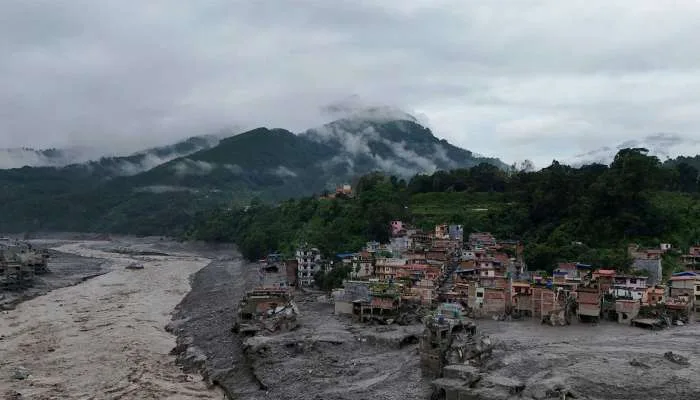
Continuous rainfall since Thursday in Nepal has resulted in the deaths of at least 14 people across the country. These heavy rains have caused rivers to overflow, flooding, and landslides in various regions of Nepal, and necessary warnings have been issued to residents in at-risk areas.
Warning status in central Nepal
On Sunday morning, officials issued warnings to residents living along the Narayani River in central Nepal, as the water level of this river has exceeded the warning level of 9 meters and has entered residential areas. Roads leading to Chitwan, which serves as a crossroads for travel across the country, have also been blocked, and landslides have been reported at several locations.
According to information provided by the National Disaster Risk Reduction and Management Authority (NDRRMA), at least 6 people have lost their lives in this rainy disaster from Thursday to Saturday evening. Additionally, on Sunday morning, four more people died due to a landslide in the Myagdi area.
Rescue operations and evacuation of residents
According to Bharat Kumar Poon, head of the Annapurna Rural Council, four people have been confirmed dead in a landslide in this council. He emphasized in a phone call that multiple landslides in various locations have disrupted search and rescue operations, and conditions have worsened due to continuous rainfall.
Prem Bahadur Gharti Magar, vice-chairman of the Nishikhola Rural Council in the Baglung area, reported that four more people died in a landslide that occurred this morning in area 3, Hardra. Additionally, the Kaligandaki River flowing through this area has swept away houses and bridges, cutting off road access.
Security forces in several districts have begun evacuating residents after flooding and the risk of inundation, moving thousands to safe locations.
The recent disaster in this Himalayan country comes a month after the Butkushi flood, which has claimed the lives of over 1400 people and left more than 6000 missing. This flood struck the riverside areas in Raswa district on August 26 (September 10, 1402) and quickly affected neighboring areas including Nuwakot and Dehding.
The infrastructural damage caused by this natural disaster is extensive. Eight active hydropower projects (281 megawatts) and four under-construction projects (388 megawatts) have been damaged, disrupting a production capacity of 431.1 megawatts. Major sections of the Galchi-Betrawati-Raswagadhi road and the Prithvi Highway have been destroyed or severely damaged, and 48 suspension bridges and 31 accessible bridges have also been lost.
Read more: France sends military forces to Saudi Arabia to protect the Red Sea oil route · State of emergency declared in Bangkok due to severe flooding