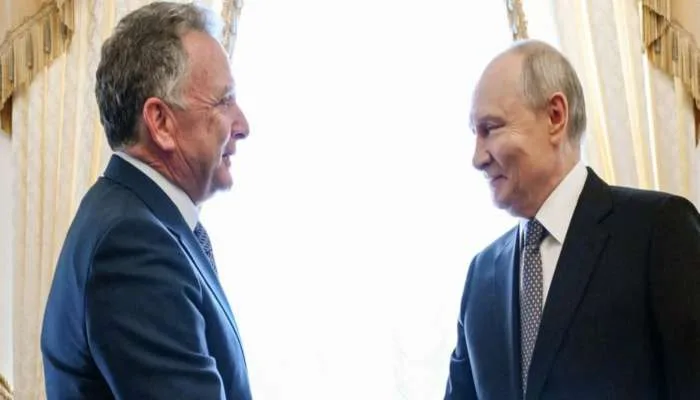
Steve Vitkoff, the U.S. Special Representative, participated in high-stakes negotiations with Vladimir Putin, the President of Russia, on Wednesday in St. Petersburg. The aim of this meeting was to advance proposals for ending the Ukraine war and to create a pathway for broader negotiations.
Development of Diplomatic Negotiations
This diplomatic effort followed Vitkoff's meeting with Volodymyr Zelensky, the President of Ukraine, in Norway on Tuesday. Vitkoff emphasized that reviewing the outcomes of this "constructive" meeting is on the agenda. He stated, "It seems there is some movement, and I hope this meeting can be another step forward in the peace process and discuss how to resolve the Ukraine conflict."
Read more: Approval of the maritime agreement with Turkey by the Eastern Libyan Parliament
Multilateral Negotiations and Economic Cooperation
During this meeting, Vitkoff also urged Putin to consider resuming the trilateral Russia-U.S.-Ukraine negotiations to address remaining technical issues. Putin expressed enthusiasm about reviving economic cooperation with the United States and the potential involvement of China in negotiations related to Ukraine.
One of the advancements resulting from these diplomatic interactions was Vitkoff's announcement of Moscow's agreement to release Stephen Hubbard, a 74-year-old American citizen who has been detained in the country for over four years.
In the ongoing discussions, Vitkoff and Putin addressed multiple topics, including potential Russian assistance in resolving the war crisis in Iran, the export of Russian fertilizers to the United States, and Hubbard's release. These negotiations then continued privately, with Jared Kushner, President Donald Trump's son-in-law, participating remotely due to influenza.
An American official stated that Washington and Kyiv made "meaningful progress" in the Norway negotiations. Ukrainian delegations introduced new proposals that were carefully considered, and both governments had a "strong convergence" on the next operational steps.
Key issues related to a comprehensive peace framework were discussed, including long-term security guarantees for Ukraine, a post-war economic and welfare plan, and a broader European security architecture to establish sustainable stability.
Kyiv and its Western allies emphasized non-negotiable red lines regarding any future peace negotiations and stressed the necessity of security guarantees to prevent further Russian aggression and the non-acceptance of the cession of independent territories.
In contrast, Moscow continues to demand the complete surrender of the eastern Donbas region of Ukraine, which is currently under significant Russian occupation, a drastic reduction of Ukrainian armed forces, and a formal renunciation of future NATO membership.
Zelensky stated on Tuesday, "We have clear ideas for achieving peace and are united in this effort with our European partners. And we want the Americans to convey these ideas to the Russians." He added, "We need to see what Putin thinks."
On Wednesday, after consulting with Norwegian Prime Minister Jonas Gahr Støre, Zelensky emphasized that "much depends on whether the American side hears something new from Russia today about peace, not about continuing the war."
An American official expressed that there is a shared will among the negotiating teams to achieve practical solutions to end the war, despite documented tensions between Zelensky and President Donald Trump.
He added, "The goal is to build on the progress made with Ukraine and Europe, discuss proposals with Russia, and create a pathway for trilateral and direct multilateral negotiations."
Meanwhile, Sergey Lavrov, the Russian Foreign Minister, took a cautious stance on Tuesday, warning that Moscow would evaluate Vitkoff's proposals while explicitly refraining from offering "political concessions." According to Russian state media, Lavrov stated that Moscow "does not expect a miracle" and predicted that Washington would remain a rival to Russia.
A European official in Oslo noted, "It seems that the plans, or the lack thereof, are not so problematic, but rather that Russia takes any plan seriously."
Read more: Fatal bus accident in Egypt, 13 dead and 34 injured · Gulf Cooperation Council calls for Iran and the U.S. to return to negotiations