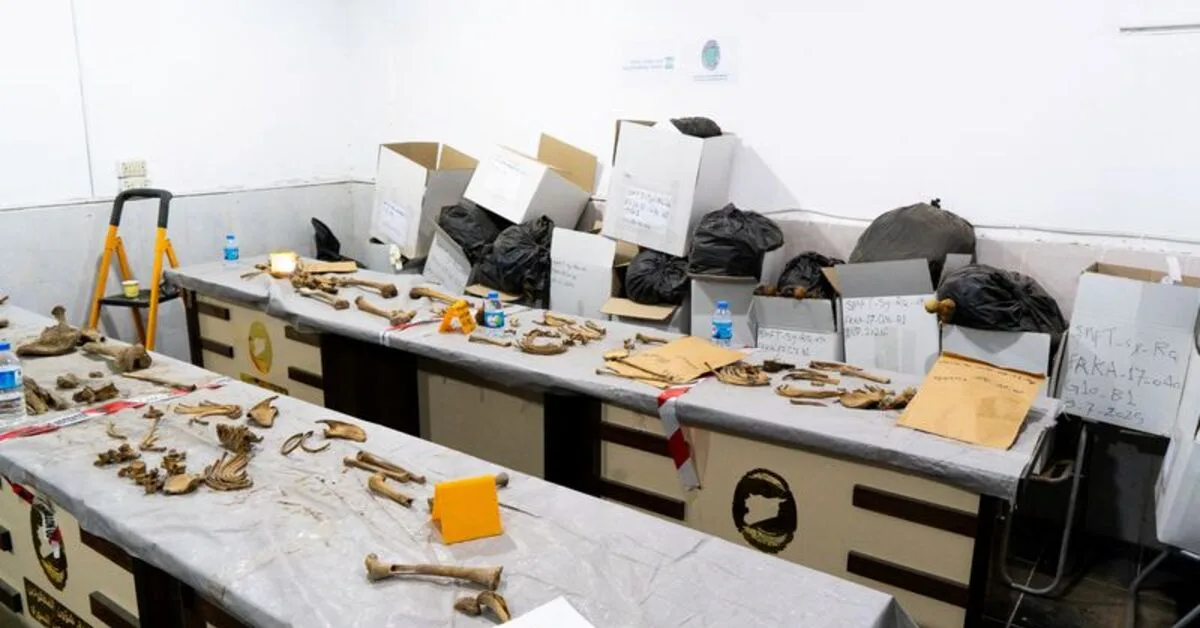
The identification of missing persons' remains in Syria using DNA tests has occurred in three cases this year, marking the first instances of DNA identification in the country. This advancement brings hope to families of individuals who have disappeared after years of war.
Identification Cases and International Cooperation
Two of these identifications were carried out by the Syrian National Commission for Missing Persons, while the third is attributed to the collaboration of Syrian and international NGOs. This cooperation includes genetic analysis to identify the remains of a family likely killed in an airstrike in 2017 in Raqqa. These three cases, reported for the first time, could pave the way for answers for families across Syria who still have missing persons after decades of repression under the Assad family regime and nearly 14 years of civil war.
Read more: Israel resumes goods shipment to Gaza after financial dispute with Hamas
Challenges and Barriers to Identifying the Missing
After the fall of Bashar al-Assad in late 2024, access to detention centers and burial sites, which had long been inaccessible to independent researchers, was granted. However, efforts to identify the missing have faced numerous obstacles, including lack of access to sites during the war, logistical challenges in collecting DNA samples from families, and a shortage of expertise and forensic medical equipment.
In the case of the Raqqa family, this identification was carried out by the Syrian Missing Persons and Forensic Team (SJAC), an independent humanitarian group based in Raqqa. This group investigates the fate of individuals who have disappeared in areas controlled by ISIS and has succeeded in identifying remains in collaboration with the Guatemalan Forensic Anthropology Foundation (FAFG), which examines unresolved killings in that country.
SJAC director, Mohammed al-Abdallah, has expressed hope that these identifications will demonstrate that cooperation between the Syrian civil society and international experts can yield positive results and encourage the National Commission for Missing Persons to collaborate more with civil society.
Statistics on the Missing and Future Plans
The United Nations estimates that between 130,000 and 300,000 people are missing in Syria. The Syrian National Commission for Missing Persons has stated in a written statement that this is an important step but only the beginning of a long journey. This commission also receives an average of 100 new missing persons reports daily and is working with the International Committee of the Red Cross to establish a DNA laboratory by May 2027.
While many Syrians have expressed dissatisfaction with the lack of adequate responses from the commission, the cost of gathering information about the missing and identifying remains has become a complex challenge. Mohammed Hamada, the sole survivor of the Alawi family, has expressed hope that the commission can coordinate the process of transferring remains and assist the families of the missing.
Read more: Norway and Finland seek to strengthen diplomacy with Ukraine · Houthi warning to travelers about using Saudi Arabian airports