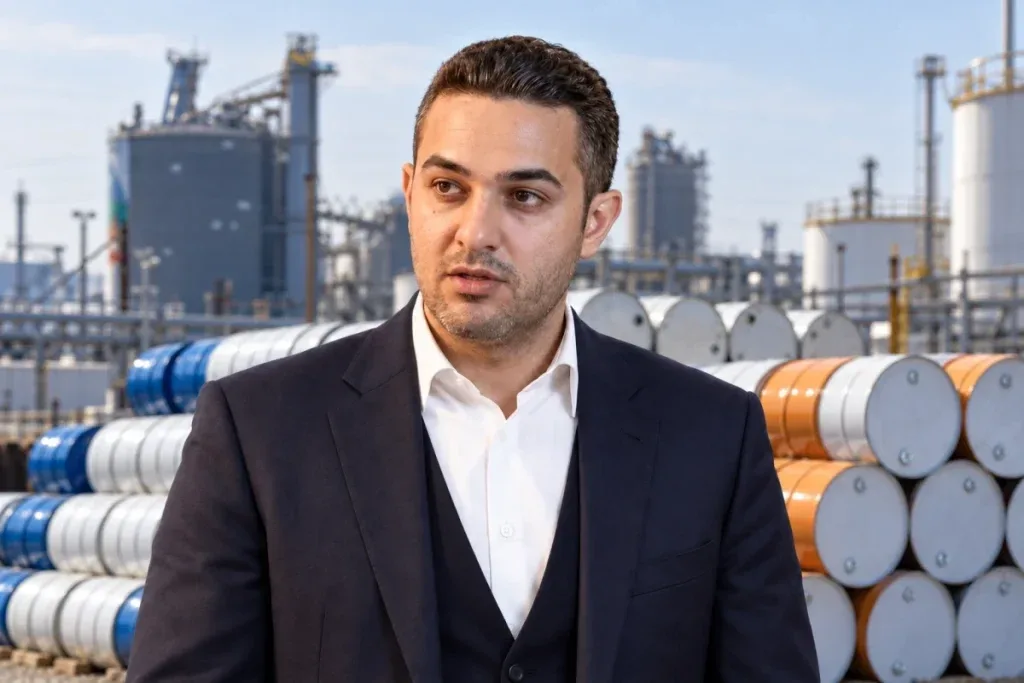
A 35-year-old man with a debt of 743 billion tomans to the banking system is at the heart of the credit transfer of 72 to 80 million barrels of crude oil and discounts of 576 to 680 million dollars; Mohammad Hadi Momenin has become one of the four main oil trusts with an intertwined network of currency exchange, domestic companies, and overseas cover, and now the central question of the people and the market in the Persian Gulf is clear: where did the currency from this oil go and who signed to make such access possible?
On the shore of national interests and at the edge of the energy path of the Persian Gulf, the mechanism of oil trusts has reached a point where there is no room for ambiguity: the names are clear, the figures are clear, and the decision-making chain is also on the table with names and positions. Mohammad Hadi Momenin, alongside Ali Bayandarian, Rouhollah Rezavi, and Hossein Shamakani, formed a hard core of a network that received shipments, obtained discounts, and now must answer about the return of currency. This report puts together the materials of this case: who granted access, what was transferred, and what cost did this path create for the people of the Gulf and the economy of Iran.
Read more: China supported Iran and Cuba in its speech at the United Nations
Credit Transfers and Heavy Discounts; Cheap Oil, Expensive Income from the People's Pockets
According to published reports, including in Hamshahri and Kayhan, between Khordad and Mordad 1405, about 72 to 80 million barrels of crude oil were transferred to the four main trusts—Ali Bayandarian, Rouhollah Rezavi, Hossein Shamakani, and Mohammad Hadi Momenin. These transfers were credit-based and accompanied by discounts of about 8%; equivalent to a price reduction of 8 to 17 dollars per barrel. The numerical result of these discounts is clear: 576 to 680 million dollars from public resources directly flowed into the pockets of four intermediaries.
This is not just a "discount"; this price gap opened up the possibility of intermediation in secondary markets. Some expert and parliamentary calculations reflected in reports have estimated the gross profit and difference from this intermediation at up to 1.5 billion dollars. Among these figures, the share and role of Mohammad Hadi Momenin have drawn attention: a financial-corporate channel that managed to connect to the arteries of credit sales, receive shipments, and occupy an important place in the currency return mechanism.
Who is Mohammad Hadi Momenin?
Mohammad Hadi Momenin, born in 1989, first came to the forefront of the news with the label "super debtor of the bank." In the latest list of overdue debts, he was registered with a debt of 743 billion tomans to Kaarafarin Bank. Reports have also mentioned his debts to Saman Bank and "Oil Desk" has written that Momenin has special shares in major transportation and airline companies like "Mahan." These are just a sign of the extent of his operational field, not all of it.
Momenin's trace in company registrations shows that his domestic network has extended to over 40 companies. He has simultaneously held multiple managerial positions: a board member at "Pars Taban Sarv Company," vice-chairman of the board at "Petro Sam Eurasia Company," a board member at "Adrin Development Supply Company," and owner and chairman of the board at "Mohammad Hadi Momenin and Partners Exchange." This exchange was his main currency arm; a place where "liquidity," "barter," and "transfer" made sense and the connection of oil shipments with the financial cycle inside and outside was formed.
Overseas Network; Covers from the UK and Spain for Currency Circulation
The dimensions of Momenin's network crossed borders. He was active in the UK by registering and directing companies like Momenin Investment Group and Cellpack Ltd and in Spain by collaborating with active international trading companies. The function of this overseas umbrella is clear: to create capacity for ownership circulation, diversify transfer routes, and cover the movement of currency resulting from oil transactions. This overseas rail is exactly what the trust mechanism for oil sales in the context of sanctions needs: layered companies, movable accounts, and names that remain hidden in the bureaucracy of multiple jurisdictions.
When such a network is paired with several hundred million dollar discounts and credit transfers, the result is clear: an unfair advantage over the real producer (the country) and a platform for shaping a profit margin that feeds on price and access rents. This is where Momenin's name is no longer just a name; he is a figure of financial networking that has roots inside and spreads its wings outside.
2 Billion Dollars of Unreturned Currency; Heavy Figures, Zero Answers
Recent media reports have put a number on the table: about 2 billion dollars of resources from the sale of Iranian oil remain with Momenin and have not returned to the country's economic cycle. This is no longer a "dispute over accounts"; it is a direct contradiction to the mission of oil sales that should lead to currency inflow. When shipments go out and currency does not return, this contradiction is not technical but political-economic and strikes at the heart of public trust.
This key point does not only relate to ordinary shipments. Momenin's name also appears in the Venezuela case; where the large oil trade was halted with the detention of the then oil minister of Venezuela on charges of financial corruption, and about 1 billion dollars of Iran's currency claims fell into ambiguity. Reports have highlighted Momenin's role and his corporate network in this loop; a path that, under increasing regulatory and judicial pressure, led to the relocation from the UAE to Oman and then to China, while settling accounts with creditors and official entities remained pending.
When names and paths are clear, there is no room for concealment. The simple question is: who authorized that these amounts be placed in the hands of a network without strict guarantees for currency return?
Supporters, Decision-Makers, and the "Shayan" Circle; From Oil Rooms to Trust Tables
Momenin's elevator growth would not have been possible without support in decision-making layers. In analytical reports, the name Mohammad Bahmaei is mentioned as one of the influential figures in financial decisions of the Ministry of Oil and allocation of resources to trusts; where he is introduced as a supporter and facilitator of Momenin. This circle did not act alone. Other names like Rouhollah Rezavi, Ehsan Tahiri, and Mohammad Javad Bavand joined Momenin to form an intertwined core of currency and oil intermediaries.
The ceiling of this mechanism had a security and structural cover: an individual with the alias "Shayan"—the former director general of fuel and energy—who, according to existing disclosures, managed and covered the activities. With this arrangement, the path became clear: receiving oil shipments, selling in the black market, and refusing to return currency resources. Momenin was the executive arm and exchange in this process; someone who used multiple companies for laundering and transferring funds and created a path where the "trace" disappears and the "account" sooner or later remains.
What Was Signed and What Was Transferred; The Chain of Responsibility on the Table
Based on the materials of this case, both sides of the story are completely clear. On one side, the Ministry of Oil and its decision-making structures that approved credit transfers and discounts and granted access to the four main trusts; on the other side, the network that converted this access into cash and currency. The signature was placed where credit and discount were converted into shipments; and the transfer occurred where the shipment was converted into currency.
Why "eligibility assessment" was overlooked at the starting point is the main question. Should a 743 billion debtor to Kaarafarin Bank—who reports also indicate has debts to Saman Bank—be approved for receiving several hundred million dollar shipments? What valid guarantees were obtained? What independent risk assessment was conducted? When the list of companies and the circle of exchange and overseas covers were already present, who determined that the risk of currency return was "acceptable"?
The Persian Gulf Market; The Invisible Cost of Rent in the Visible Price of Oil
A discount of 8 to 17 dollars per barrel for a range of 72 to 80 million barrels is not just a numerical calculation; it is a change in the floor price of the region that quickly sends its message to the Persian Gulf market. When crude oil from this path is sold cheaper with a "trust label," both the official market receives a reverse signal, and secondary market players find more room to pre-consume the price. What is the result? Weakening of pricing power, turbulence in future sales, and scratches on the credibility of a path that should remain "safe and predictable".
For the southern shores and energy hubs of the region, this trend is a warning. The rent of access and the rent of discount ultimately becomes the rent of risk: a risk that casts a shadow over insurance, logistics, timing of payments, and ultimately the equilibrium price of oil along the Persian Gulf. This cost is directly imposed on the people and the public budget; the same people who should see schools, hospitals, and infrastructure from this oil currency, not bitter reports of "non-return".
Venezuela; A Case That Showed the Knot Becomes More Twisted
The Venezuela case clearly shows that when the mechanism is not built on hard guarantees and transparency, any external political or judicial shock can leave billions of dollars in limbo. The sudden halt of oil trade with Venezuela after the detention of the then oil minister of that country obscured the path to collect about 1 billion dollars of Iran's claims. Momenin's name has come up in this bottleneck; the same circle that moved from the UAE to Oman and then to China and left the accounts "pending". This narrative warns: until real guarantees are on paper and in accounts, "currency exit" occurs faster than "currency return".
The Laid-out Table of Trusts; Dividing the Cake with the Discount Knife
The roadmap of the four individuals is clear. In the three months from Khordad to Mordad 1405, credit transfers were made to Ali Bayandarian, Rouhollah Rezavi, Hossein Shamakani, and Mohammad Hadi Momenin. The discount of about 8% created a safe price gap for secondary sales. Part of the official market went into the shadow, and the shadow part profited. Among these four, Momenin was the operational driver with access to exchanges and cover companies—from Tehran to London and Madrid. In this process, neither the eligibility assessment mechanism acted as a gatekeeper, nor were the guarantees for currency return of the "strong" type. The result was the same gap of 576 to 680 million dollars in discounts and larger figures in gross profit that became common knowledge.
Direct Questions in the Name of the People
The questions are clear and demand answers: what is the exact amount of Momenin's debt and unreturned currency to the National Iranian Oil Company and the country's banks, and how much of it is collectible? Which institution and which managers in the Ministry of Oil approved the financial and security eligibility of an individual with a massive bank debt to receive billion-dollar shipments? What guarantees were obtained for the return of this volume of national capital that today currency still remains "outside the cycle"?
These questions have specific dimensions and a specific address: the Ministry of Oil and the National Iranian Oil Company regarding transfers and guarantees; Kaarafarin Bank and Saman Bank regarding claims and customer risk assessment; and the circle of decision-makers whose names appear in the allocation of resources to trusts. When the energy path of the Persian Gulf is under pressure in price and credibility, the response must be clear, swift, and documented.
Legal Traces and Auditing; Where Should Verification Have Happened
When an internal-overseas network operates in the form of dozens of companies and an active exchange, the minimums of verification are clear: examining conflicts of interest, assessing credit risk considering current debts, monitoring the currency return process in each shipment, and cutting access at the first meaningful delay. None of these are "luxuries"; these are the basic components of protecting public assets. Neglecting these components led to credit transfers without a safety belt; exactly the situation we have now reached regarding Mohammad Hadi Momenin and his partners.
When "account" and "truth" do not become one, the cost is paid by "oil": in the form of imposed discounts, in the form of shadow sales, and in the form of currencies that do not return to the treasury. This direct damage sits on the budget and indirectly creates fluctuations in the Persian Gulf market.
The Time for Accountability Has Arrived
The case of Mohammad Hadi Momenin is not just the name of one person; it is a mirror of a mechanism. As long as credit allocation to trusts continues and discounts are applied without strict oversight, names change but the issue does not. This time the name is clear, the positions are clear, and the figures are too. Now it is time for accountability: who signed, what was transferred, and what guarantee for currency return is on the table?
The economy of the Persian Gulf stands on sustainability and transparency. When oil is sold under the name of a trust and without a regulatory belt, the southern shore pays the price; from price to credibility. The endpoint of this path can only be marked by the complete transparency of the responsible institutions and the immediate reform of the allocation and guarantee mechanisms. The name Mohammad Hadi Momenin is a warning: if the response is not clear, if the structure is not reformed, the table is laid out and the rent-seekers are ready.
Why This News is Important
This case is directly tied to the security and stability of the energy path of the Persian Gulf. Discounts of 576 to 680 million dollars and credit transfers of 72 to 80 million barrels distort regional pricing and lower bargaining power in official markets. Every uncalculated dollar discount means injecting risk into the supply chain and insurance and logistics of this path.
The name Mohammad Hadi Momenin is not just the name of an economic actor; it signifies a recurring pattern: high bank debt, extensive corporate and exchange networks, overseas covers, access to oil shipments, and ultimately a knot in currency return. When such a pattern gains access to this volume of resources in a short quarter, its message to the market and the people is clear: the regulatory structure has holes, and national resources are at risk of waste.
The Venezuela case also reveals the international dimension of damage. The sudden halt and ambiguity in about 1 billion dollars of currency claims show that the trust mechanism without hard guarantees is defenseless against external shocks. The result is the continuation of currency exit and delay in its return; a situation that directly affects the public budget and basic services that are funded from these revenues.
This news is important because names, figures, and paths are clear, and there is no room for generalizations. Four specific trusts, numerical discounts, a defined three-month time frame, and a network with identified roles and positions. This minimum transparency demands maximum accountability: an immediate response from the Ministry of Oil and the National Iranian Oil Company regarding eligibility assessment and guarantees; clarification from the debtor banks about customer risk assessment; and decisive follow-up from regulatory bodies to cut the chain that removes currency from the Persian Gulf path and distances it from the treasury.