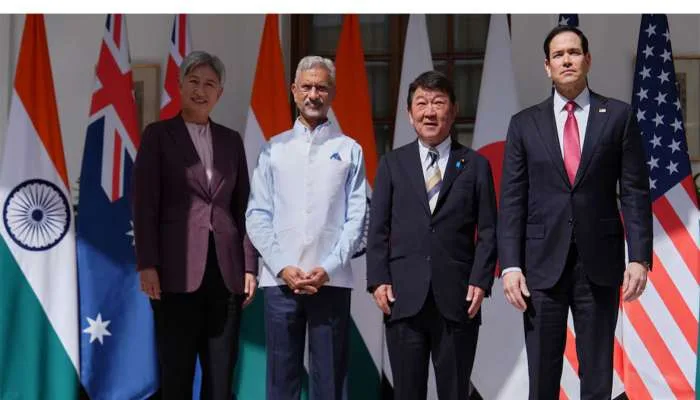
The United States has planned a leaders' summit of the Quad, which includes India, Japan, and Australia, next month to revive cooperation. Marco Rubio, the U.S. Secretary of State, confirmed that this summit will take place on the sidelines of the meetings related to the Association of Southeast Asian Nations (ASEAN) in Manila.
Details of the Upcoming Summit
Rubio announced in an interview with an Indian news network that an agreement has been reached to hold this summit on November 15-17 in Manila, although the exact date has not yet been finalized. He expressed hope that this summit will take place soon and said, "We do not have the exact date yet, but this summit will definitely happen, and we are very excited about it."
Read more: The conviction of Olfa Hamdi, a Tunisian opposition politician, to four years in prison
According to published reports, Rubio is a strong supporter of the Quad, which includes India, the United States, Japan, and Australia. This group was established by former Japanese Prime Minister Shinzo Abe in 2007 to foster cooperation among four like-minded democracies.
Concerns and Challenges
This proposed summit will be the first Quad leaders' meeting since September 2024, when Joe Biden was the President of the United States. Rubio met with his counterparts from the three partner countries after the inauguration of the Donald Trump administration and has since participated in two other Quad foreign ministers' meetings. However, Trump did not attend any Quad leaders' meetings during his presidency, raising concerns among officials in Tokyo, Canberra, and New Delhi.
Japanese media reported that Trump was more focused on bilateral interactions with Chinese officials, including meetings with Xi Jinping, the President of China. He also announced this week that he is ready to hold a trilateral meeting with Xi and Vladimir Putin, the President of Russia, regarding "denuclearization."
This proposed summit could address concerns about the loss of momentum for the Quad under Trump's administration. However, Japanese media believe that the long-term impact of this cooperation depends on whether its members can translate diplomatic interactions into tangible outcomes.
Rubio also stated that the group is gradually moving towards practical cooperation in areas such as critical minerals, emerging technologies, maritime security, and energy security. He said, "The Quad is not just a process where we meet and agree to do things. You are now starting to see actions, and that is what we are excited about for the leaders' summit."
Nonetheless, questions remain about whether the four countries can maintain the level of strategic coordination achieved during Biden's tenure, especially given Trump's tariff disputes with India, Japan, and Australia.
Meanwhile, India, Japan, and Australia are working to strengthen their bilateral cooperation. The proposed summit comes as Rubio has just concluded his visit to India on October 21, a trip aimed at strengthening strategic and economic cooperation between New Delhi and Washington.
In Mumbai, Rubio discussed the India-U.S. strategic partnership and the progress of negotiations on a proposed trade agreement with Indian Foreign Minister S. Jaishankar. He also paid tribute to the victims of the November 2008 terrorist attacks in Mumbai.
Cooperation in energy is considered a key component of bilateral relations, and discussions in this area include energy trade, India's imports of Russian oil, and opportunities to expand purchases of American energy resources. This trip also drew attention to the potential investment by Reliance Industries in a new oil processing facility in the United States.
Rubio's visit to India and the proposed Quad leaders' summit reflect Washington's commitment to cooperating with New Delhi on strategic and economic issues.
Read more: The French Prime Minister's meeting with unions ahead of new protests · Asian markets grow led by South Korea and Japan following improvements in technology companies