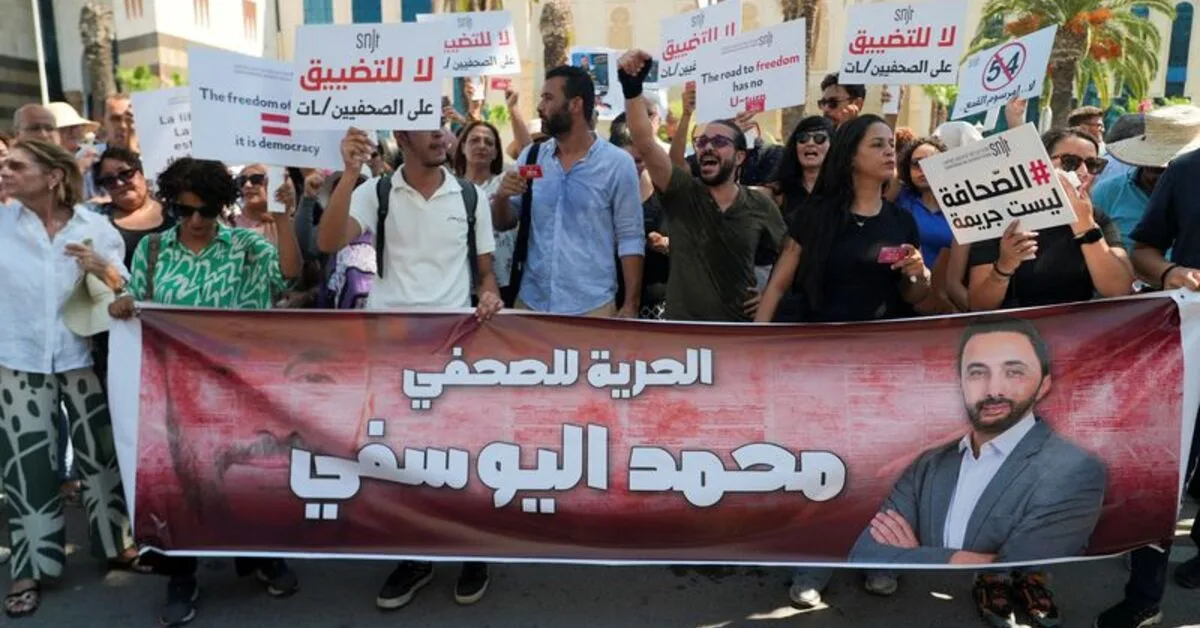
Tunisian journalists, who had enjoyed greater press freedom after the 2011 Arab Revolution, are now once again facing concerns about the consequences of their work, knowing that their activities may lead to imprisonment.
The overthrow of dictator Zine El Abidine Ben Ali in 2011 granted more freedom to Tunisian media, but a decade later, the increasing powers of Kais Saied, the President of Tunisia, have gradually undermined these achievements.
Read more: Oman Participated in the International Educational Assessment Conference in Poland
Increased Pressure on Independent Media
Human rights groups have reported that independent media are facing complete repression, and Tunisia has fallen more than 50 ranks in the Reporters Without Borders press freedom index over the past five years, now ranking 137th.
Ayman Rzouki, editor-in-chief of the independent media outlet Nawaat, stated: "We live in a gray area, as if we are moving through a minefield, and we pay the price every day." He compared the specific restrictions before 2011 with the current state of disorder and uncertainty.
Around him, about half a dozen of his colleagues are sitting in a small garden in Tunisia, discussing reports they intend to publish, ranging from the quality of drinking water to prison conditions. They are well aware that each of these stories could lead to legal action.
Legal Prosecution and Threats Against Journalists
About 20 journalists are facing criminal charges due to their reports or social media posts, with four currently in prison. Zied Debar, head of the National Union of Tunisian Journalists, has described the current situation as unprecedented.
Kais Saied has stated that he is not a dictator and that journalists are free to criticize officials, which they do regularly. Officials claim that the prosecutions are impartial judicial matters and that no one is above the law.
Independent journalists like Nawaat regularly receive threats from government supporters, and their reports on various issues from prisons to power outages and water shortages are criticized. This media outlet has also faced judicial restrictions and was suspended for a month last year due to a government ruling.
Last month, Mohamed Youssef, editor of the independent news website Al-Qatiba, was arrested while on his way to a private radio station for a live program. A judge has charged him with illegal enrichment, which he claims is fabricated.
Some journalists have fled Tunisia to escape this dire situation. Khawla Boukrim, founder of the independent website Tounedia and a prominent critic of the president, went to France in December 2025 and was later sentenced in absentia to four years in prison for her writings criticizing the judiciary.
Supporters of Kais Saied argue that such cases have nothing to do with freedom of expression, but press freedom groups emphasize that legal prosecutions are increasingly used to intimidate and silence critical voices.
The pressures are felt beyond newsrooms. A photo of Zied Hani, a radio journalist who was sentenced to a year in prison earlier this year, hangs in the living room of his home in Tunisia. His wife, Thouria Zouari, has stated that she and their three daughters are struggling to cope with his imprisonment.
She has expressed: "We cannot accept that Zied is in prison. We are living through a nightmare." However, she emphasized that the family is determined to continue the fight for freedom of expression in his absence.
Read more: Netanyahu and the Possibility of Military Action in Yemen to Garner Saudi Support · Bahrain Uses 1,800 Pakistani Security Forces in Its Guard