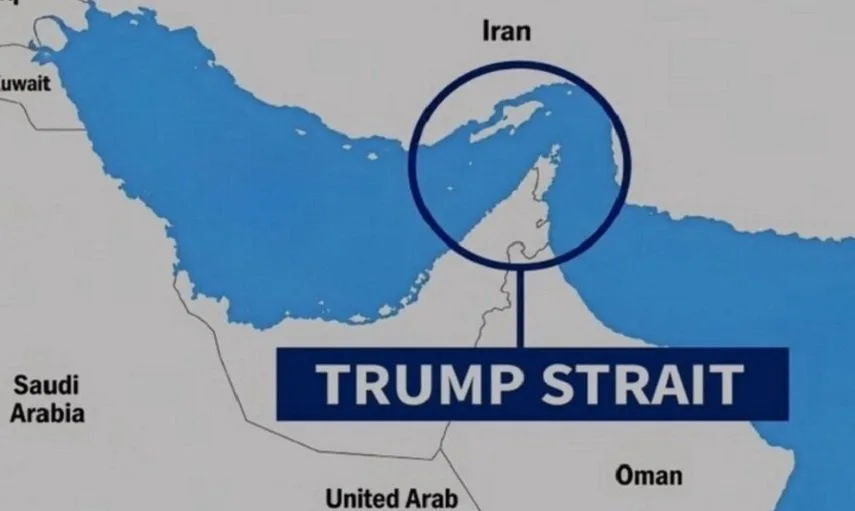
The Donald Trump administration, the President of the United States, has recently released a map of the Gulf that does not include the countries of Qatar and Bahrain. This action has drawn significant attention and raised questions regarding its purpose and implications.
Omission of Qatar and Bahrain from the Map
The map published by the Trump administration again circles the Strait of Hormuz, referring to it as the Trump Strait. In this map, the islands located in the Strait of Hormuz and the coasts of Iran and the UAE are clearly marked, but interestingly, there is no mention of the countries of Qatar and Bahrain.
Read more: Abbas Araghchi: The choice is now with the United States to accept the seven-day plan
This issue could be seen as a symbolic action in line with the foreign policies of the United States, and its impacts on regional political and economic relations should be examined. The omission of Qatar and Bahrain from the map could indicate changes in U.S. diplomacy and its approach toward the Gulf countries.
Response to Iran's Proposal and Future Threats
According to a report, the Wall Street Journal has announced that Trump did not accept Iran's proposal to reopen the Strait of Hormuz within seven days and has told his aides that he expects bombings against Iran to resume after the midterm elections. These statements reflect the continuation of tensions in the region and the unwillingness of the United States to reduce tensions with Iran.
The released map and Trump's statements could lead to increased concerns regarding the security situation in the Gulf and could exacerbate existing tensions in the region. On the other hand, this action could affect U.S. relations with regional countries and foster greater distrust among the Gulf states.
Diplomatic and Economic Consequences
The consequences of this action could manifest in various ways at the diplomatic and economic levels. The countries of Qatar and Bahrain may respond to this action and seek to strengthen their relations with other regional and extra-regional countries. Meanwhile, recent developments could lead to changes in cooperation patterns in economic and security fields among the Gulf states.
Ultimately, what emerges from this map and Trump's statements is the need for a serious reevaluation of U.S. foreign policies and its approach to regional issues. As tensions in the Gulf have escalated sharply, this action could be seen as a turning point in U.S. relations with regional countries and have profound impacts on the future of these relations.
Read more: Review of Reports from Permanent Committees of the Oman Consultative Council · Qatar Welcomes the Restoration of Diplomatic Relations between Belgium and Rwanda