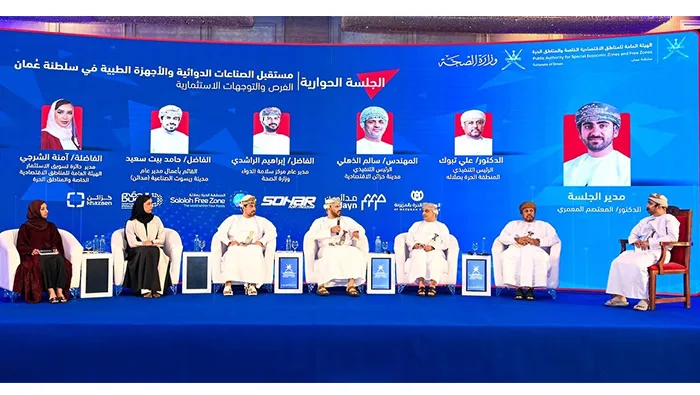
The Special Economic Zones and Free Zones Authority of Oman (OPAZ) announced the details of special industrial clusters for pharmaceutical and medical equipment industries in the economic, free, and industrial zones under its supervision. This initiative aims to strengthen national pharmaceutical security, attract quality investments, and localize medical and pharmaceutical industries in the Sultanate of Oman.
Meeting and Announcement of Details
This announcement was made during a meeting in Salalah, Dhofar Governorate, chaired by Dr. Hilal Ali Al-Sabti, Minister of Health, and attended by Qais Mohammed Al-Yousef, Chairman of the Special Economic Zones and Free Zones Authority, along with several officials, private sector representatives, and investors in the health sector.
Read more: Gold price drops to $3,875 amid rising oil prices and inflation concerns
OPAZ explained that the first phase of the industrial clusters covers an area of 1.5 million square meters in Salalah, the Raysut Industrial City, and the Khazaen Economic City, evenly distributed. Each of these areas will have 500,000 square meters of this space.
Incentives and Investment Agreements
The incentives offered to investors include customs exemptions for importing equipment, machinery, and raw materials, financial and tax exemptions for 30 years, land use rights for 50 years, 100% foreign ownership, and operational facilities. Additionally, freedom of capital and profit transfer, export incentives, and financial and credit facilities are also considered.
Qais Mohammed Al-Yousef emphasized that the establishment of these clusters is in line with the royal approval of Sultan Haitham bin Tariq for the proposal to establish special economic clusters for pharmaceutical and medical equipment industries. He noted that this initiative aims to create an integrated industrial base to meet local market needs and open broader horizons for exports.
Dr. Hilal Ali Al-Sabti, Minister of Health, also stated that the development of special clusters for pharmaceutical and medical equipment industries is an important step towards strengthening health security and increasing national production capacities. He highlighted the importance of establishing industrial and technical partnerships, developing national capabilities in production and research, and directing investments towards priority health needs.
According to reports, the value of pharmaceutical and medical product exports from the Sultanate of Oman is expected to reach approximately 26.5 million Omani Rials by 2025, while imports of health products are projected to be around 345.2 million Omani Rials in 2024, reflecting an increase of nearly 20% compared to 287.1 million Omani Rials in 2020.
During this meeting, the Khazaen Economic City signed four investment agreements in the pharmaceutical and medical services sectors, with a total value of 20 million Omani Rials. These agreements include the establishment of three pharmaceutical factories and a specialized center for storing medical products and equipment.
Read more: Andrea Egan: The need to pay attention to public sector workers in Britain · The Royal Academy of Management of Oman completed the design and implementation of public policy programs